The St. Louis Blues Have Plenty of Options at Center After a Busy Offseason – The Hockey Writers – St Louis Blues

The St. Louis Blues made improving the center position one of the biggest priorities of their offseason, and their moves have given them considerably more flexibility heading into the 2026-27 season.
The Blues added two players who can potentially play significant minutes down the middle, acquiring Connor McMichael from the Washington Capitals in the Jordan Kyrou trade before landing Mason McTavish from the Anaheim Ducks at the 2026 NHL Draft. Those additions came as the Blues continued reshaping a roster that finished 37-33-12 last season and averaged 2.80 goals per game, 24th in the NHL.
The result is a forward group with far more possibilities than it had a season ago. Robert Thomas remains the clear number-one center, but the Blues now have several players who can play center or move to the wing depending on how the lineup develops. Players can also move up or down the lineup without forcing the team to completely change its structure.
That flexibility is what makes the center position particularly interesting heading into training camp. The Blues do not necessarily have to find four centers and leave them in those spots all season. Instead, they can experiment with different combinations and adjust based on performance, chemistry, and the needs of the lineup.
Thomas Remains the Anchor
There should not be much debate about who starts at the top of the depth chart.
Thomas is coming off a 64-point season in which he led the Blues with 25 goals and 39 assists in 64 games. He also reached at least 60 points for the fifth consecutive season, becoming the first Blues player since Vladimir Tarasenko to accomplish the feat. Thomas was particularly productive after the 2026 Winter Olympic break, scoring 14 goals and recording 31 points over the final 25 games of the season.
Thomas gives the Blues a dependable first-line center and allows the organization to focus its attention on what happens behind him. The biggest question is whether McTavish can establish himself as the second-line center, because if he can, St. Louis could have a much stronger top six than it did last season.
That is not the only possibility, however. Pius Suter remains a legitimate middle-six center after recording 13 goals and 29 points in 64 games last season, while Dalibor Dvorsky enters his second NHL season after recording 12 goals and 21 points in 71 games as a rookie.
If Dvorsky takes a significant step forward, the Blues could give him more responsibility and move him higher in the lineup. If he needs more time, they have enough depth to keep him in a manageable role rather than forcing him into a position simply because they need another center.
That is the type of flexibility the Blues have created with their offseason moves.
McTavish Gives St. Louis Its Biggest New Variable
McTavish is where the possibilities become especially interesting.
The Blues acquired the 23-year-old from Anaheim on June 26, sending the Ducks the 15th- and 29th-overall picks in the 2026 NHL Draft. McTavish was the third0overall selection in the 2021 NHL Draft and has already played 304 regular-season games in the NHL. He recorded 17 goals and 41 points in 75 games last season, along with six points in 10 playoff games as the Ducks reached the second round.
The obvious starting point is to give McTavish an opportunity at center. If he can establish himself as a legitimate second-line center, the Blues suddenly have a strong one-two combination with Thomas, giving them the ability to spread their offensive talent throughout the lineup rather than relying heavily on one line.

The important part, though, is that McTavish does not have to succeed at center for the Blues to benefit from the trade.
If the Blues determine that McTavish is better suited to the wing, they can move him there and use another player in the middle. That could mean McMichael moves to center, Suter moves up the lineup, or Dvorsky receives an opportunity to take on a larger role.
McTavish’s ability to move to the wing also gives St. Louis a way to keep his offensive talent in the lineup without forcing him to remain at a position if the fit is not right. The Blues can start him at center, evaluate how he handles the role, and make an adjustment without creating a major hole elsewhere.
That is a significant luxury for a team that has spent the past several seasons searching for consistency throughout its lineup.
McMichael Creates Another Route
The Blues created another option when they traded Kyrou to Washington on June 23.
St. Louis received McMichael, prospect Milton Gastrin, and the 16th-overall pick in the 2026 NHL Draft in exchange for Kyrou. McMichael had 14 goals and 46 points in 78 games for Washington last season after setting career highs with 26 goals and 57 points in 2024-25. The Blues later signed him to a six-year, $40.5 million contract with an annual average value of $6.75 million.
McMichael’s versatility could be particularly valuable for St. Louis because he does not have to be locked into the center position. NHL.com described him as a player capable of playing multiple positions up front, which gives the Blues another way to adjust their forward group.
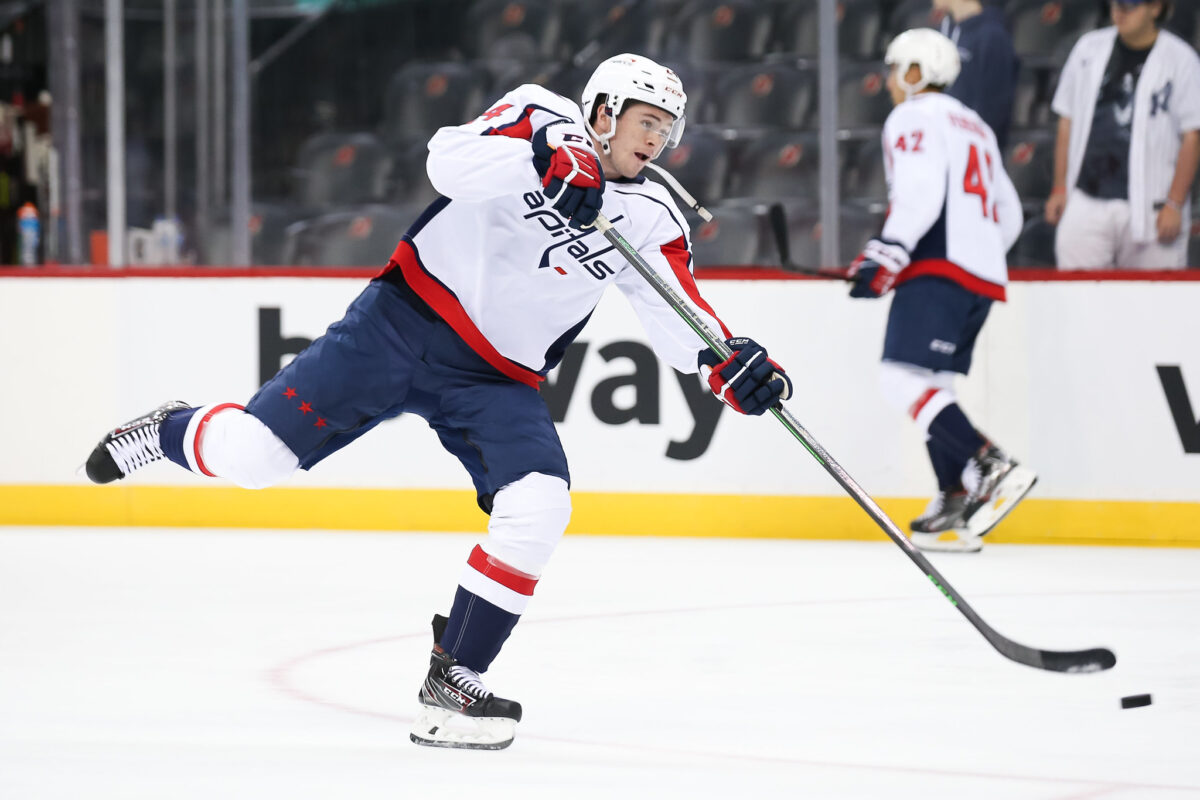
For example, the Blues could begin the season with McTavish at center and McMichael on the wing. If McTavish struggles in the middle, McMichael could move to center, and McTavish could shift to the wing. If McMichael does not produce enough in a top-six role, he could move down a line while another forward moves up.
The same flexibility applies to the rest of the forward group. Pavel Buchnevich, who has spent time at center when the Blues have needed another option, can now remain on the wing more consistently because St. Louis has added enough natural center depth. That allows the Blues to keep one of their more experienced wingers in a familiar role while using their deeper group of centers to handle the middle.
It also means the team does not have to make one move to solve every problem. If one player struggles, another player can fill the vacancy without forcing the entire lineup to be reconstructed.
Dvorsky Could Change the Equation
Then there is Dvorsky, who could become one of the biggest young prospects in determining how the center group eventually looks. The 2023 10th-overall pick already has a full NHL season under his belt, and his 12 goals as a rookie provided a foundation for his development. His 21 points in 71 games were not eye-popping numbers, but the Blues should not need to rely on him as a top-line center immediately.
If Dvorsky makes a major jump during training camp or early in the season, St. Louis can reward him with more responsibility. That could mean moving him into a second- or third-line center role and pushing another player down the lineup.
If he does not take that step, the Blues can keep him in a smaller role and rely more heavily on their veterans and new additions. That is particularly important for a young player. Instead of needing Dvorsky to immediately become one of the team’s most-important centers, the Blues can allow his performance to determine how quickly he moves up.
The organization also has other options behind its primary group. Oskar Sundqvist can provide depth in the middle while also playing on the wing. Jack Finley appeared in 22 NHL games last season, and Otto Stenberg played 32 games while recording three goals and seven assists. Aleksanteri Kaskimaki also remains a developing center in the organization after putting up 44 points in 64 games for the Springfield Thunderbirds in the American Hockey League last season.
None of those players necessarily needs to be a major part of the Blues’ center group, but their presence gives the organization additional insurance.
The Biggest Advantage Is the Depth
Ultimately, the Blues’ biggest improvement at center may not be any individual player. It could be the number of different ways they can construct the lineup.
Thomas can remain the number-one center while McTavish gets the first opportunity behind him. If McTavish succeeds, the Blues have a strong second-line option. If he struggles, he can move to the wing while McMichael, Suter, or Dvorsky takes over at center.
McMichael can play in the middle or on the wing. Dvorsky can move up the lineup if he proves ready or remain in a smaller role if he needs more time. Suter can take on additional responsibility, while Buchnevich no longer needs to be considered a regular option at center and can remain on the wing.
The Blues can also adjust their lines without necessarily moving everyone around. A player who is not producing in a top-six role can move down a line, while someone performing well can earn more responsibility. That gives head coach Jim Montgomery the ability to let the players’ performance determine the lineup rather than being forced into a specific structure because of a lack of alternatives.
There is no guarantee every combination will work, and the Blues still need to determine which players have the best chemistry together. McTavish has to prove he can handle a significant role at center, McMichael needs to rebound from his 46-point season, and Dvorsky needs to continue developing after his rookie campaign.
What the Blues have now, however, is the ability to respond if one of those players does not meet expectations.
A player can move to the wing, another can move into the middle, a struggling forward can move down a line, and a player who earns a bigger opportunity can move up. The Blues have built enough depth that they do not have to treat one lineup combination as their only solution.
After making the center a clear priority this offseason, the Blues enter 2026-27 with more talent down the middle than they did last season.
Free Newsletter
Get St Louis Blues coverage delivered to your inbox
In-depth analysis, breaking news, and insider takes – free.