The Canadian Holy Grail – Charlie Angus / The Resistance
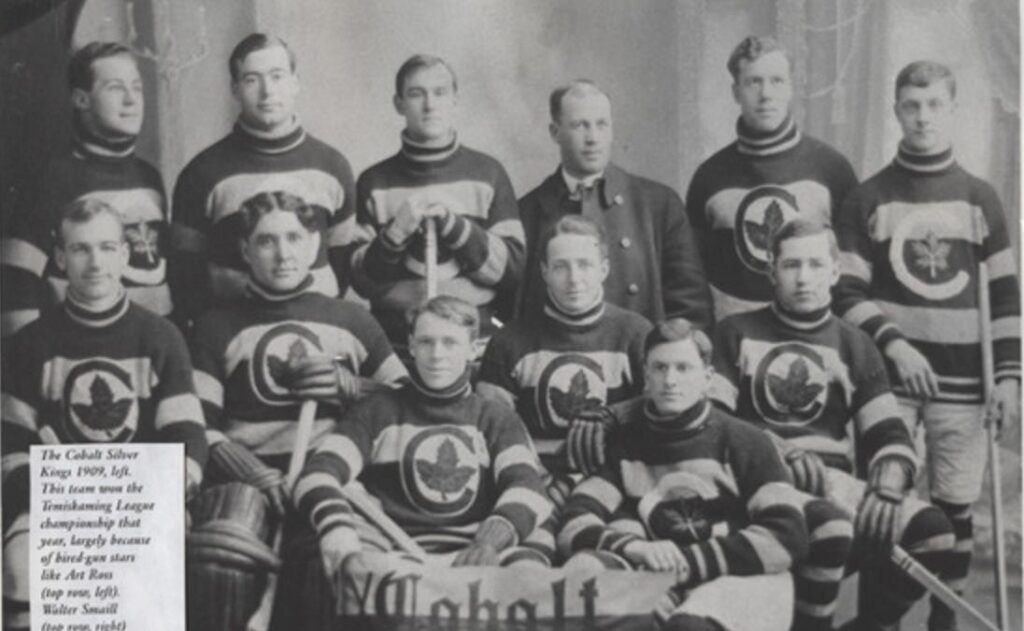
For this week’s summer reading series I want to share with you the story of a mythic hockey game that seems so unreal that it could only have been told by a storyteller like Kinsella.
But this isn’t a flight of fancy. It really happened in the boom (then bust) mining town of Cobalt and it led to the birth of the Montreal Canadiens – the Lions of Winter.
The research for this story was part of my book Cobalt: Cradle of the Demon Metals.
The Stanley Cup–winning Montreal Wanderers arrived in the silver mining town of Cobalt, Ontario, on January 24, 1909, to play the Cobalt Silver Kings at the local arena. The newly built facility had the capacity for 3,500 spectators, with 2,800 seats and standing room for another 700. A special tearoom with a glass wall ensured spectators stayed warm while watching the hockey game below.
More than 3,000 Cobalters showed up to watch the Stanley Cup Champions.
When the Wanderers took to the ice, excited fans leaning forward in the standing gallery caused the railing to give way, and seven men fell to the ice below. But in typical Cobalt fashion, the game quickly got underway after the badly injured men were sent to the hospital.
Montreal was led by star defenceman Art Ross, who played a revolutionary style of hockey by taking control of the puck in the Montreal end and leading the team’s offence by rushing the puck up into the other end.
Ross made several spectacular rushes into the Cobalt zone but was frustrated by the lack of space — because of the town’s desire to fill the arena with seats for fans, the ice was forty feet shorter and thirty feet narrower than the Wanderers were used to playing on.
Not only were they hemmed in on all sides by the tough Cobalt team, but they were also blocked by the solid goaltending of “Chief” Joseph Henry Jones, a hired professional gun from the Michigan leagues. Cobalt won the game 6-4.
Goalie Joseph Jones was an exceptional athlete and the first professional Indigenous hockey player a full half century before the famous Fred Sasakamoose broke the racial barrier in the NHL.
The other Indigenous connection in this game was Art Ross, who was fluent in Ojibwa, having spent his childhood at a Hudson Bay post in Northern Ontario. Following the game, Jones and Ross joined the other players for a celebratory dinner at Goodall’s, Cobalt’s finest restaurant. Although sport has often excluded non-white players, silver miners allowed Jones to cross that barrier.
The mining magnates had been carefully watching the Stanley Cup team because they were scouting prospects for their upcoming regional showdown between the two rival local teams — the Cobalt Silver Kings and the Haileybury Comets. At the time, hockey was a regional game played by amateur teams.
However, the mine owners had large amounts of disposable income to indulge their sports and gambling interests. On the morning that the Montreal team was boarding their private train to return south, centre man Harry Smith announced he was staying.
Even though Montreal had a game the next night against their arch rivals the Ottawa Senators, Smith had seen the lure of mining money and agreed to play for the Haileybury Comets in the upcoming finals against Cobalt.
Smith’s salary came from mine owner Noah Timmins. Just a few years earlier, Noah and his brother Henry had been shopkeepers in Mattawa. In the summer of 1903, prospector Fred Larose came into the shop to purchase supplies while waiting for the train.
He told Noah about a fantastic discovery he had made along the rail line in Northern Ontario. He showed some impressive silver samples. The Timmins brothers immediately got a loan of $3,500 and bought out Larose’s share. They established a consortium to exploit the rich silver veins of the Larose Silver Mine.
But the powerful Renfrew industrialist Michael John (M. J.) O’Brien had claims on the same large hill staked by Larose. The legal battle between the Big Cobalters, as it came to be known, was eventually settled with the Timmins brothers taking the front side of the hill and O’Brien controlling the rear end of the property. There was enough silver in that hill to make the competing Big Cobalters fantastically rich, and they decided to carry on their rivalry in the world of hockey.
With Montreal’s centreman picked for Haileybury, Cobalt manager Tom Hare headed out to hire some stars to even the field. Ottawa Senators captain Bruce Stuart turned down an offer of $400. Hare then moved on to Montreal, where Art Ross and Walter Small agreed to play in the two-game finals for the extraordinary fee of $1,200.
With so much riding on the outcome, the two players were brought into Cobalt secretly, just before the game on February 23, 1909.
Home ice advantage went to Haileybury.
At the Matabanic Hotel in Haileybury, the betting was intense. Art Ross remembers seeing $40,000 (the equivalent of $1.5 million today) change hands in twenty minutes. The Haileybury managers flooded the ice with small surges of water to make the surface uneven in the hope it would slow down Ross. But it wasn’t the ice that caused Ross trouble; he was targeted for serious violence from the Haileybury team.
Early in the game, Ross took a stick to the head and was laid out on the ice with a concussion for nearly twenty minutes. He was covered in blood, and the doctors worked hard to put his nose back in place. Wobbling to his feet, Ross led another rush for the puck behind Haileybury’s bench but was speared in the stomach with a stick and fell to the ice. For good measure, Haileybury goon Tommy Smith kicked him in the chest with his skates.
Nonetheless, Ross scored the first goal — and then, the Toronto Star remembered, “the real dirty work commenced.” Ross took another shot to the head while Walter Small was hit hard and sent to the ice three times. The only Cobalt player to escape being bloodied was goalie Chief Jones. Regardless, Cobalt won 7–1.
After the game, Cobalt fans showed up at Ross and Small’s hotel and showered their room with nuggets of pure silver. The two men were considered too beat-up to continue the series, but they decided they wanted vengeance on Haileybury.
The Haileybury mining men, believing the two Montreal stars were finished, raised the betting odds in favour of a Haileybury win, and Noah Timmins alone was reported to have put $40,000 down on a Haileybury victory. Two other Haileybury fans bet everything they owned on the game.
But then Ross and Small came out to play for the first period to the delight of the Cobalt fans. Just before dropping the puck, local mine doctor Dr. Eddie Phillips, as referee, told the players, “The sight of blood, men, is no novelty to me.”
Cobalt was leading 5-1 heading into the break. Haileybury came back to tie the game, but it wasn’t enough. Leslie McFarlane, who later went on to fame as the author of the Hardy Boys series using the name Franklin W. Dixon, stated that the final period was the “roughest period of hockey ever played anywhere.”
The game ended with a Cobalt victory, and the fans showered the ice with money and chunks of high-grade silver. Haileybury goalie Paddy Moran grabbed a tub of ice from the dressing room, filled it with as many silver nuggets as possible, and then sat on the tub to protect it.
Cobalt wanted to use this victory to challenge for the Stanley Cup, the preeminent prize in Canadian hockey since 1893. The cup was awarded to the winner of a showdown between the top teams in the amateur leagues, which tended to be the English-speaking teams of Ottawa or Montreal. However, by 1908–09, money was beginning to separate the amateurs from the pros.
The Stanley Cup consortium rejected Cobalt’s bid because they had beaten Haileybury with the aid of two professional hired guns. The organization also pointed out that Cobalt’s arena lacked a regulation ice surface. The mine owners promised the rink would be ready for a full pro team in the winter, but the hockey establishment was unwilling to open their doors to the upstart team from northern Ontario.
Angered by this rejection, Cobalt mine owners developed a plan to undermine the Eastern Canadian Hockey Association by creating a new mining league that would feature Cobalt, Haileybury, and the Renfrew Millionaires.
In December 1909, they formed the National Hockey Association (NHA) with the existing teams and added a francophone team to draw fans in Montreal, which at the time had only two English teams (the Shamrocks and the Wanderers). They were called the Montreal Canadiens.
Mining barons Tom Hare and Ambrose O’Brien paid the $1,000 league entry fee for the Canadiens, and then kicked in $5,000 in salaries to get them launched. In their first pro game on January 5, 1910, the Montreal Canadiens beat Cobalt 7–6 in overtime.
The overspending by Renfrew, Cobalt, and Haileybury couldn’t last. The teams were soon in debt and, one by one, slipped from the league. The CHA was absorbed into the National Hockey Association, which, by the middle of World War I, became the NHL. The only one to survive was the Montreal Canadiens, a team that had been formed as an amusement by the Cobalt silver barons.
A few years ago, the town of Cobalt shut the local arena because of a disappearing tax base. Kids who used to spend their winters playing on the ice were left playing on their screens.
As for the Montreal Canadiens? They remain a dominant force in pro sports.