How the Buffalo Sabres Stack up Against the Atlantic Division in 2026-27 – The Hockey Writers – Buffalo Sabres

The Buffalo Sabres are heading into the 2026-27 season as defending Atlantic Division champions. They recorded 50-plus wins for the third time in franchise history (2006-07 / 2007-08).
Now, heading into the new season, they have had some roster changes. They decided to move on from both Alex Tuch and Bowen Byram. Tuch was traded to the Washington Capitals in a sign-and-trade, while Byram was traded to the Chicago Blackhawks for the fourth overall pick and more.
The team over the offseason decided to go down the route of relying on internal growth in the forward group rather than trading for an established player. On the back end, however, they traded for Byram’s replacement in Olen Zellweger, who I think will flourish in Buffalo.
What about the rest of the Atlantic Division? The Florida Panthers are healthy, besides Brad Marchand, and they also acquired Brady Tkachuk from the Ottawa Senators and Jacob Markstrom from the New Jersey Devils. The Boston Bruins acquired J.J. Peterka, the Tampa Bay Lightning signed John Carlsson, and the Toronto Maple Leafs drafted Gavin McKenna first overall and traded for Darryn Raddysh, then immediately signed him to a contract extension.
Even with all of those moves from within the division, how do they stack up on paper against the rest of the Atlantic?
Boston Bruins
The Bruins had a solid offseason, highlighted by their draft‑night splash in acquiring Peterka from the Utah Mammoth. Beyond that move, they’re largely bringing back the same core group.

Up front, Boston still leans on its top trio of David Pastrnak, Morgan Geekie, and Pavel Zacha. Adding James Hagens should help, and Fraser Minten is expected to take another step to address some of their scoring and depth concerns. Still, Buffalo holds the advantage here. With another season of Josh Doan, one of the league’s premier goal scorers in Tage Thompson, and expected growth from Zach Benson, Konsta Helenius, Jiri Kulich, and Noah Ostlund, the Sabres simply have more depth and upside throughout their forward group.
On defense, the gap widens. Outside of Charlie McAvoy, Boston’s blue line lacks the depth required for a deep playoff run. Mason Lohrei remains a question mark, Hampus Lindholm’s future form is uncertain, and the bottom pair of Nikita Zadorov and Henri Jokiharju has limitations, even with Will Borgen added for stability. Buffalo, meanwhile, features a Norris finalist in Rasmus Dahlin, plus Owen Power, Mattias Samuelsson, and newcomers Zellweger and Louis Crevier. The Sabres finished third in defensive scoring last season, and even with Byram gone, Zellweger should slide into his role seamlessly.
Goaltending is the one area where Boston has a clear edge. Jeremy Swayman was a Vezina finalist and played a major role in their first‑round battle with Buffalo last season. While Ukko‑Pekka Luukkonen and Alex Lyon were excellent for the Sabres, some regression is reasonable to expect. Swayman remains the more proven option.
Forwards: Sabres
Defense: Sabres
Goaltending: Bruins
Detroit Red Wings
The Detroit Red Wings have had a rough offseason. Their captain, Dylan Larkin, requested a trade, Steve Yzerman stepped down as general manager, and Patrick Kane returned to Chicago. It’s been setback after setback.
Their forward depth remains a major concern. Outside of Larkin, Alex DeBrincat, and Lucas Raymond, they lack reliable scoring. Viktor Arvidsson helps, but not enough to close the gap between them and Buffalo. The Sabres have significantly more firepower with Thompson, Benson, and a deeper supporting cast that includes Jason Zucker, Ryan McLeod, Beck Malenstyn, and Peyton Krebs. Detroit simply doesn’t have the depth to match that.
Defensively, the Red Wings are stronger, led by Moritz Seider and Simon Edvinsson, with Axel Sandin‑Pellikka adding upside. But beyond those three, the blue line thins out quickly. Buffalo, meanwhile, has an elite No. 1 defenseman and three more high‑end options, plus a solid bottom pair: a level of depth Detroit can’t match.
Goaltending is closer. John Gibson is still a serviceable starter at this stage of his career. He posted a .901 save percentage (SV%) last season, which is respectable, but still a tier below Luukkonen’s .907. Buffalo holds the edge here as well.
Forwards: Sabres
Defense: Sabres
Goaltending: Sabres
Florida Panthers
The Panthers, when healthy, have one of the deepest rosters in the league. Entering this season, they finally have Aleksander Barkov and Matthew Tkachuk back after both missed significant time last season. Their forward group is loaded with talent: Sam Reinhart, both Tkachuk brothers, Barkov, Carter Verhaeghe, Marchand, and Anton Lundell, who centers their third line. Few teams can match that combination of star power and depth.
On defense, Florida has a strong top pair with Aaron Ekblad and Gustav Forsling leading the way. The unit is above league average overall; they may not have a true game‑breaker as Buffalo does, but head coach Paul Maurice’s structure and the veteran presence throughout the lineup make them consistently reliable. Still, the Sabres’ blue line is deeper and more dynamic, giving Buffalo the edge in this category.
Goaltending is the one area where Florida has some uncertainty. They let Sergei Bobrovsky walk and traded for Markstrom from New Jersey. If the team stays healthy, Markstrom should be solid enough to keep them competitive. Compared to Buffalo, though, their goaltending is just a bit weaker, even if the gap isn’t huge.
Forwards: Panthers
Defense: Sabres
Goaltending: Sabres
Montreal Canadiens
The Sabres’ second‑round opponent from last season, the Montreal Canadiens, enter this season with one of the deepest and most dangerous forward groups in the league. They have both depth and star power: Cole Caufield is coming off a 50‑goal season, Nick Suzuki hit 100 points, Ivan Demidov led all rookies with 62 points, and Juraj Slafkovsky added 73. Their supporting cast is just as strong, with Alex Newhook, Kirby Dach, and Alex Texier all stepping up in the playoffs. As much as it stings to admit, Montreal has the edge up front, and it isn’t particularly close.
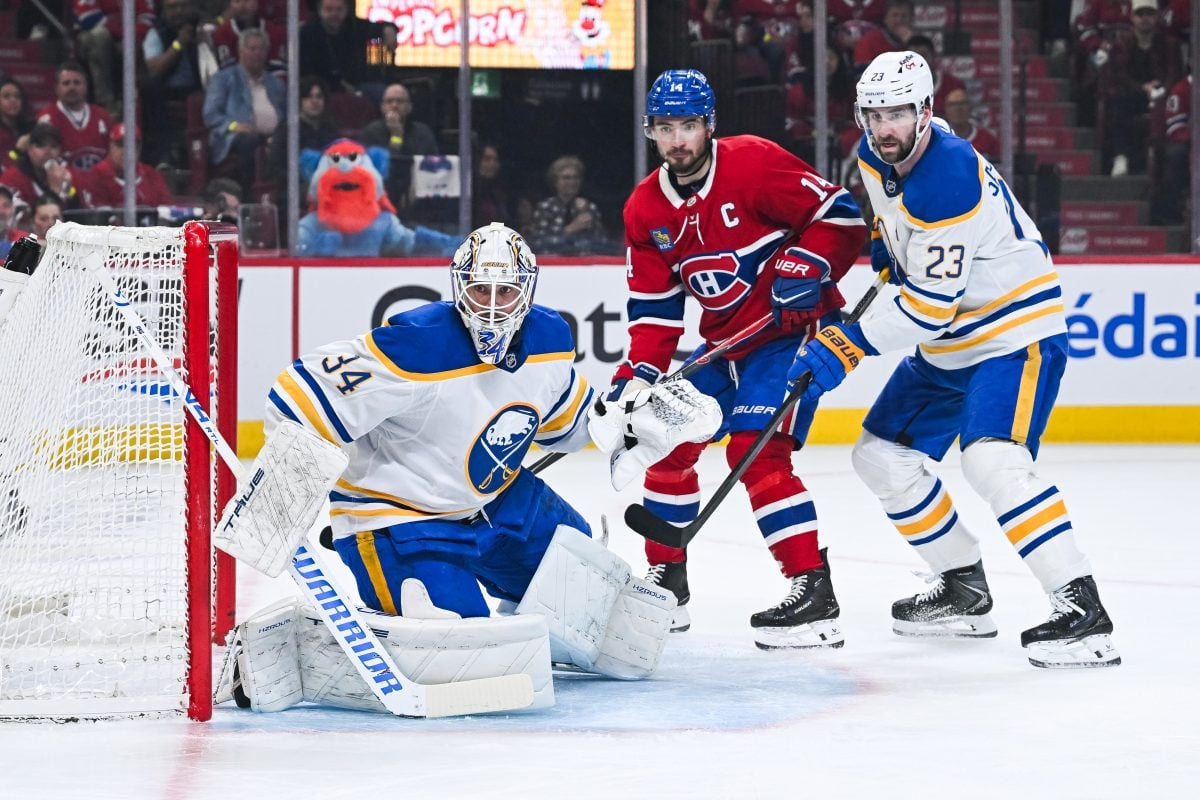
On defense, both teams boast Norris‑caliber talent in Dahlin and Lane Hutson. Montreal’s supporting group of Noah Dobson, Kaiden Guhle, and Mike Matheson is very solid, but Buffalo’s top four has a slight advantage in overall depth and reliability. It’s a tight comparison, but the Sabres get the nod.
Goaltending leans toward Montreal. Jakub Dobes was outstanding in the 2026 postseason, posting a .908 SV%, and he enters this season with a new contract and plenty of momentum. He looks poised to continue that upward trajectory, giving the Canadiens the edge in net as well.
Forwards: Canadiens
Defense: Sabres
Goaltending: Canadiens
Ottawa Senators
The Ottawa Senators have a quietly strong forward group. Even after moving Tkachuk, they added William Eklund from the San Jose Sharks and brought back Claude Giroux on a one‑year deal. With Tim Stutzle, Drake Batherson, Dylan Cozens, and Shane Pinto, there’s plenty of talent throughout their top nine. The Senators and Sabres are very close in forward depth, but Buffalo gets a slight edge thanks to Thompson’s star power and a bottom six that produces a bit more. It’s a tight comparison.
Ottawa’s blue line is one of the best in the league, and the same can be said for Buffalo’s. Jake Sanderson is rapidly becoming a top‑five defenseman, and Thomas Chabot remains a steady partner. Their second pair of Artem Zub and Jordan Spence is a luxury most teams don’t have. Still, Buffalo’s top four of Power, Dahlin, Samuelsson, and Zellweger offers more overall upside, with the potential to combine for around 170 points.
Goaltending is the simplest category to evaluate. Linus Ullmark is the clear advantage for Ottawa. His performance in the first round last season showed he’s still capable of elite play, and he should be able to post a .910 SV% or better while helping the Senators push for another playoff berth.
Forwards: Sabres
Defense: Sabres
Goaltending: Senators
Tampa Bay Lightning
The Tampa Bay Lightning have the Sabres beat in pure star power up front. Their top six features Nikita Kucherov, Brandon Hagel, Jake Guentzel, Anthony Cirelli, and Brayden Point, five players who could all play on a first line. With Cirelli and Hagel anchoring the second line, Tampa’s top end is elite. Their bottom six isn’t as strong, though it did improve with the additions of Ilya Mikheyev and Jeffrey Viel. Even so, the Lightning hold the edge in the forward department.
On defense, the situation flips. Buffalo clearly has the stronger blue line. Outside of John Carlson and Victor Hedman, Tampa’s depth thins out quickly. J.J. Moser is a reliable second‑pair option, and Erik Cernak remains a strong shutdown defenseman, but the Sabres have more quality pieces they can rotate and rely on throughout the lineup.
Goaltending is the easiest comparison of all. Andrei Vasilevskiy, the reigning Vezina Trophy winner, continues to be one of the most dominant goaltenders in the league. Whenever Tampa needs a save, he delivers, a major reason behind all three of their Stanley Cup runs from 2020-2022 and their regular‑season success last season.
Forwards: Lightning
Defense: Sabres
Goaltending: Lightning
Toronto Maple Leafs
Last but not least are the Toronto Maple Leafs, who completely reshaped their depth this offseason. By adding Nick Paul, Colton Sissons, Jack Roslovic, and Brandon Duhaime, their bottom six should be far stronger than many expect. At the top of the lineup, drafting McKenna was massive, and if Auston Matthews stays healthy, he’s a near‑lock for 50‑plus goals. This forward group is genuinely underrated, and on paper, they edge out the Sabres.
Defensively, the story mirrors much of the division: Buffalo’s depth gives them the advantage. Toronto’s acquisition of Raddysh was a smart move, but beyond him and Morgan Rielly, the blue line thins out quickly.
Goaltending remains below average. Bobrovsky will be an upgrade from last season’s tandem, which was Anthony Stolarz and Joseph Woll. He’s coming off a career‑worst season and isn’t getting younger. Luukkonen is the better option right now, which gives the Sabres the edge in net.
Forwards: Maple Leafs
Defense: Sabres
Goaltending: Sabres
Even after losing some important players, the Sabres still stack up impressively against the rest of the Atlantic. Their roster is built to compete, their young core is ready to rise, and they should remain a force among the division’s seven opponents.
Free Newsletter
Get Buffalo Sabres coverage delivered to your inbox
In-depth analysis, breaking news, and insider takes – free.