A Wild Ride to Game 83 — The Fourth Period
Because firing a coach is the easiest lever to pull, it creates urgency and resets accountability. It gives players no place to hide but it also quietly shifts the spotlight away from roster construction, from decisions made months earlier that put this group in this exact position.
And that’s where this one gets complicated.
Hiller didn’t lose the room in some dramatic, headline-grabbing way – it wasn’t a full disconnect. If anything, it felt more like a slow drift, the kind where messages stop landing the same way. It’s where repetition turns into noise, where players hear it, but don’t necessarily execute it.
That’s harder to fix.
And in those situations, organizations almost always choose change over patience.
The timing, though, that’s the tell.
You don’t make that move unless you believe the season is still salvageable. Unless you think the group has more to give and just needs a jolt and to their credit, there was a response. Not perfect, not dominant, but a response. Structure tightened (at times), compete level ticked up. And suddenly, games that slipped away earlier in the year started leaning back in their favor.
So, what does that say?
It says the players had another level – but weren’t reaching it consistently. And it says the organization believed that level was worth chasing, even if it meant making a move that doesn’t solve everything.
Because it doesn’t.
Firing Hiller didn’t fix the roster. It didn’t suddenly create scoring depth or eliminate defensive lapses. What it did was strip away excuses, as it forced the group to own what was left of the season.
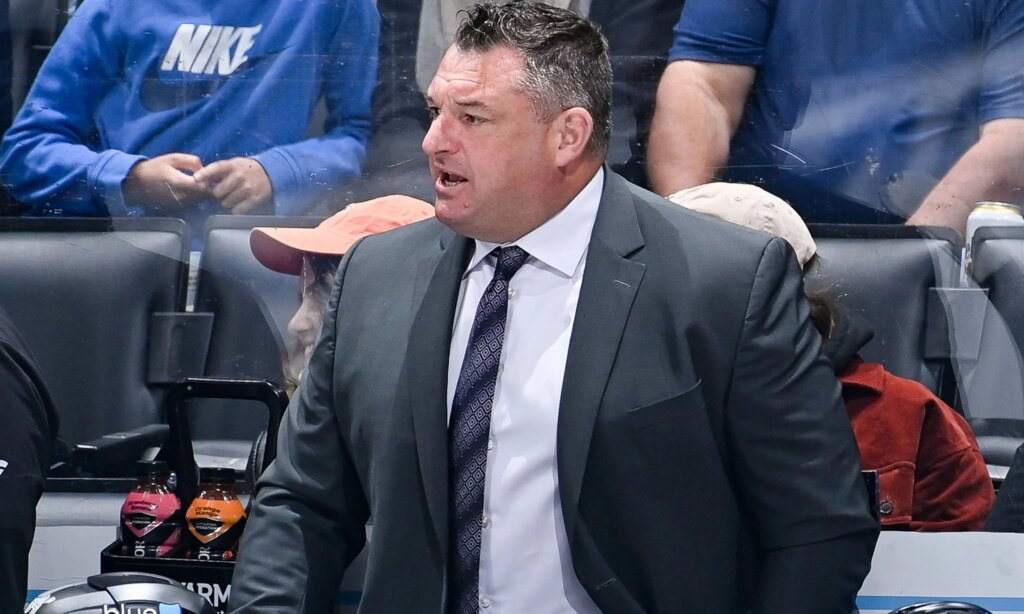
Enter D.J. Smith.
And here’s where it actually gets interesting.
Because the impact wasn’t about a systems overhaul or some dramatic philosophical shift. This wasn’t a tear-it-down-and-rebuild-on-the-fly situation. Smith didn’t come in and reinvent how they played. He simplified it by stripping it down.
Less thinking. More playing.
You could see it almost immediately with shorter shifts and quicker decisions. A team that wasn’t trying to make the perfect play as often – and as a result, making more effective ones. The structure didn’t disappear, but it became more direct. Pucks got in deep, defense moved quicker. And for the first time in a while, there was a sense that everyone knew their job – and just did it.
That’s where things started to shift.
Not dramatically. Not in some Hollywood, rip-off-10-in-a-row way but subtly. A win here, a game they probably lose earlier in the season that they found a way to grind out. Then a stretch where the structure tightened just enough, the mistakes trimmed just enough, and the goaltending – finally – held firm.
And now you’re looking at a team that didn’t dominate its way into this position, it survived into it.
That’s the part that makes this season hard to define. Because on paper, you can point to the standings, the late season winning streak against a soft schedule and say they got where they needed to go. But watching it every night, living it shift-by-shift, it never felt that clean.
There were too many nights where they chased the game. Too many stretches where the offense dried up and everything felt like it had to be perfect just to score once. Too many moments where you asked, “What exactly is this team’s identity?”
The change to Smith brought urgency without overcomplicating it. There was accountability, but it wasn’t layered in messaging that had gone stale. It was clear and direct and for a group that had started to drift, that clarity hit.
You saw it in the details first. Board battles won and much needed net-front presence are the little things that don’t show up until they do. Then it translated into results, not dominant wins – but necessary ones, the kind this team wasn’t consistently getting earlier in the season.
And let’s be honest, that also reset the goaltending conversation.
No one had Anton Forsberg as the season’s savoir. No one had him as the NHL’s first star during the most critical week of the season for the Kings. The loyalty to Darcy Kuemper was obvious, he had earned it from last season’s Vezina-nominated performance, but his regression left the coaching staff with little choice but to turn to Forsberg.
Another beneficiary was Quinton Byfield, but his dominant scoring run at the end of the season (11 goals in his last 15 games) was a function of having less pressure on his shoulders with the emergence of the Artemi Panarin-Anze Kopitar-Adrian Kempe line as the No.1 forward line much more than the coaching change.
But with Smith behind the bench, it started to feel like there was finally a lane. Not necessarily a full commitment, but a direction. That alone stabilized things just enough for the rest of their game to fall into place.
Now, does that mean everything is fixed?
No.
The same roster questions still exist. The same limitations are still there but what Smith did was remove the fog. He gave this team a version of itself that was easier to execute, easier to trust, and frankly, harder to beat on a given night.
And that’s why the response came not because the team suddenly became something it wasn’t – but because it finally started playing like something it could be.
Which, in the end, might be the most telling part of all.
And yet, here they are.
Still in it. Still forcing the conversation to continue longer than it probably should have at different points in the year.
And as a reward for their late season rush, starting Sunday the Kings will face the Colorado Avalanche, the odds-on favorite to win the Stanley Cup.
Colorado possesses all the tools to expose Los Angeles’ weaknesses and most believe the Avalanche will breeze into the second round of the NHL Stanley Cup Playoffs to face the survivor of the heavyweight matchup between the Dallas Stars and Minnesota Wild. Though we’ve thrown a good number of roses at Smith, despite the late season run, there’s zero guarantee when the season concludes Holland will remove the interim tag in front of his name or even be part of next season’s coaching staff.
That’s the paradox of this season.
They didn’t become what many expected… but they didn’t fall apart either. They existed in that uncomfortable middle ground, where every win felt necessary and every loss felt heavier than it should.
Maybe that’s the real story.
Not a team that arrived, but a team that refused to disappear.
And sometimes, in this league, that’s enough to keep writing chapters a little longer than anyone saw coming.
Game 83 awaits.