Demidov Conundrum: Canadiens Second Line Options
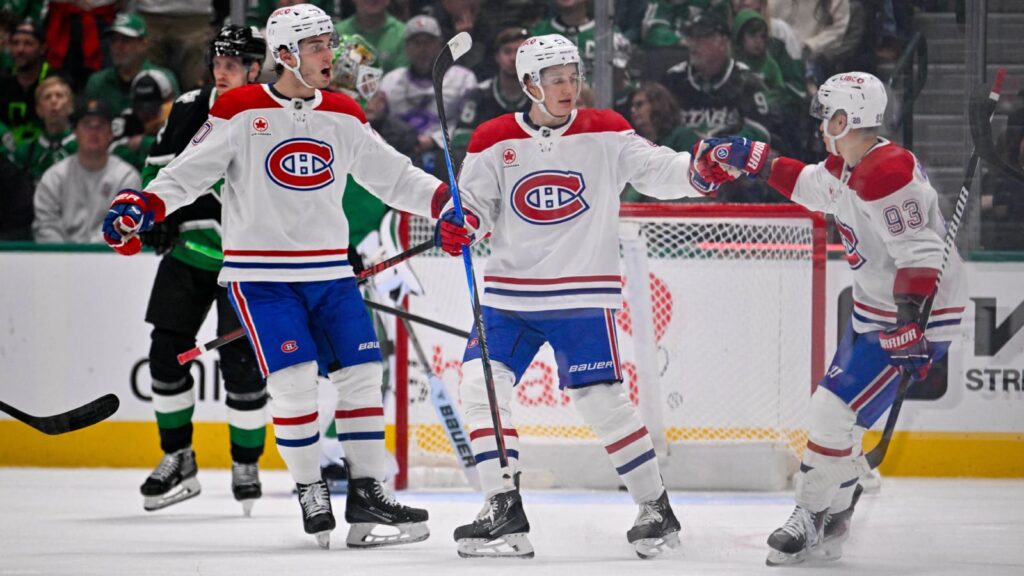
It was clear from the very get-go that Montreal Canadiens winger Ivan Demidov had the skill set necessary to immediately make an impact in an NHL lineup.
With a 62-point rookie season in the books, it’s also fair to suggest that he enjoyed a successful freshman campaign with the Habs.
However, when evaluating his ice time, it’s also evident that he was used sparingly in certain situations. Whenever the Canadiens were involved in a tight-fought game, Demidov was given very few shifts in the final minutes of the third period.
It’s not an uncommon strategy for head coach Martin St-Louis, seeing as he also stapled Juraj Slafkovsky to the bench in the final five minutes of close games throughout his rookie season.
In that vein, we can propose that St-Louis was attempting to protect his rookies, rather than limit their usage.
Finding More Ice Time For Ivan Demidov
St-Louis eventually found the ideal role for Slafkovsky, slotting him on the first line alongside the team’s best players: Nick Suzuki and Cole Caufield.
I would argue that’s also a potential solution to Demidov’s relatively low ice time at 5v5, which ranked 19th on the team last year, to the tune of 11:22 per night.
To be perfectly fair, St-Louis also handed Demidov three minutes of powerplay ice time per game, significantly more than most rookies enjoy in the NHL. It was his way of improving Demidov’s scoring pace, while simultaneously sheltering him at 5v5.
Either way, seeing as Slafkovsky, Suzuki, and Caufield produce dominant numbers together at 5v5, tearing that trio apart makes little to no sense, even if the goal is to increase Demidov’s usage. It would be the hockey equivalent of robbing Peter to pay Paul, and in this case, Peter brings much more value to the table.
Logically speaking, St-Louis will have to find an internal solution to the second-line woes, without mitigating the incredible positive impact from his first line.
Second Line Options
Now that Demidov is preparing for his second year in the league, he will be counted upon to provide much better underlying numbers at 5v5, though it will be a rather tall hill to climb, all things considered.
He mostly played alongside fellow rookie Oliver Kapanen, spending over 750 minutes with the Finn, compared to just 180 minutes apart. The discrepancy in teammate usage skews their stats considerably, but there’s no ignoring that when the two were on the ice, the Montreal Canadiens failed to control the majority of the important underlying statistics.
Such is life as two rookies playing in the top-six, or at very least, Montreal’s version of the top six, with a few caveats about usage in the dying minutes of the third period.
The pair only managed to control 44.4% of the shots, which means Canadiens goaltenders had to deal with over 800 shots, while opposing goaltenders were limited to just 642 shots.
This discrepancy in results was repeated throughout every major statistical category, except one: goal share.
Together, Demidov and Kapanen controlled almost 55% of the goals, with a 47-39 advantage at 5v5.
Now, I’m not here to tell you it’s a sustainable strategy. If you run that season in a simulator 100 times, they would probably end up with a goal share closer to their expected goal share, which was just 45%.
But the fact of the matter is they controlled the goals while they were on the ice, which is much better than the alternative for most lines that struggle with shot share.
It should also be noted that when Slafkovsky was briefly used on the second line, he did not improve the numbers considerably. Their shot share was just 46%, and their expected goals almost hit 47%.
And yet, they still managed to finish on the right side of the goal share, with 58% (25-18).
Even when Alex Newhook was used alongside Kapanen and Demidov, the goal share remained positive (59%, 20-14), despite being outshot regularly (42.2%).
The only forward who spent more than 100 minutes at 5v5 with Demidov on the second line and managed to finish above 50% in shot share was Alexandre Texier (52.4%), but we’re dealing with a very limited sample size.
Montreal Canadiens Brass Tacks
Given the situation on the second line, Canadiens management has been busy shopping the price tags of nearly every available forward in the NHL. They have yet to pull the trigger on a deal, likely because of the elevated cost of young, established pivots.
Simply put, finding a true No. 2 centre on the NHL market is easier said than done. As a result, the Habs will likely open the 2026-27 season with the same options down the middle, and the same underlying defensive issues on the second line.
Both Demidov and Kapanen will have more experience by then, but unless Montreal can acquire a defensively responsible centre who also offers more natural offensive ability than Philippe Danault or Jake Evans, the bulk of the pressure in the most important shifts will once again fall on Suzuki, Caufield, and Slafkovsky.
Consequently, Demidov’s ice time would remain limited when the game is on the line, unless, of course, Texier elevates his play enough to become the one forward capable of fixing the second line’s concerning shot-control numbers.
All Montreal Canadiens statistics are 5v5 unless otherwise noted, via Natural Stat Trick.