Pittsburgh Penguins’ Melvin Fernstrom Faces a Make-or-Break Development Season – The Hockey Writers – Pittsburgh Penguins
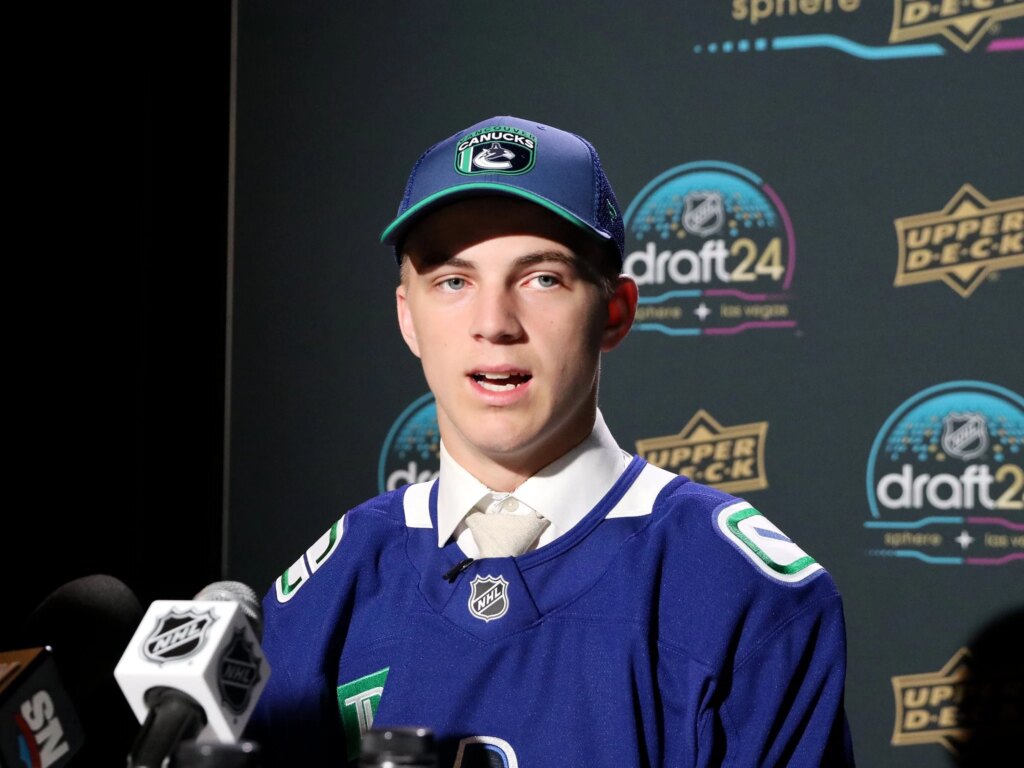
Melvin Fernstrom’s first full season under contract with the Pittsburgh Penguins included a disappointing start, an encouraging restart and an injury that prevented a definitive evaluation.
The Penguins traded Marcus Pettersson and Drew O’Connor to the Vancouver Canucks in January 2025 for Danton Heinen, Vincent Desharnais, Fernstrom and a conditional first-round pick – that selection eventually became No. 12 in the 2025 Draft and was included in the series of trades that helped Pittsburgh select Bill Zonnon and Will Horcoff.
Fernstrom joined the organization as an intriguing scoring winger who had just won the Swedish Hockey League’s (SHL) Rookie of the Year honors. One year later, he is ranked No. 20 in PensBurgh’s Top 25 Under 25 after producing only four points in Sweden, but showing improvement with the Wilkes-Barre/Scranton Penguins of the American Hockey League (AHL) and then losing the remainder of his season to an apparent arm injury.
The difficult season does not make Fernstrom a failed prospect. It does make 2026-27 a critical test of whether his promising AHL introduction can become a sustainable professional role or whether he begins slipping behind the Penguins’ growing collection of young forwards.
Fernstrom’s Swedish Season Erased His Momentum
Fernstrom seemed positioned to build on a breakthrough campaign when the Penguins signed him to a three-year entry-level contract in June 2025. He had recorded eight goals and 17 points in 48 games for Örebro HK of the SHL, leading all league rookies in goals, assists and points. When Pittsburgh announced Fernstrom’s contract, they highlighted his dominant junior production, including 42 goals and 82 points in 66 games for Örebro’s J20 Nationell team.
That combination made him a worthwhile secondary piece in the Pettersson trade. He was not considered a premium prospect, but he had produced against experienced professional competition as a teenager and appeared capable of becoming a skilled middle-six winger if his skating and all-around game continued developing.
The following season disrupted that projection. Fernstrom recorded three goals and one assist in 36 SHL games, a substantial decline from his rookie campaign. His minus-10 rating was not solely his responsibility, but the lack of offense showed that he was struggling to create enough chances or earn a role that might restore his confidence.
The Penguins eventually decided that continuing the loan was no longer helping his development, and Örebro confirmed in January that Pittsburgh was bringing him back to North America before the end of the SHL season. The decision represented more than a routine assignment change. Pittsburgh was taking greater control over Fernstrom’s development after a season that had moved in the wrong direction.
AHL Response Kept Fernstrom Relevant
Fernstrom’s move to Wilkes-Barre/Scranton immediately produced more encouraging results. He recorded two goals and six assists in 14 AHL games, including three points in his first two games and later reached six points through eight contests, showing that the transition to a smaller North American rink did not overwhelm him.
That production mattered because the AHL generally gives young forwards less time to make decisions than the SHL. Fernstrom had to adjust to more direct forechecking, increased physical pressure and a schedule that demanded quicker recoveries between games. His early scoring suggested that his offensive instincts remained useful despite the difficult start in Sweden.
The improvement also supported parts of Fernstrom’s draft profile, which emphasized his ability to find space, finish chances and create offense through intelligent positioning. He has never projected as a forward who will dominate through strength or straight-line speed, so his value depends on processing the game quickly enough to reach productive areas.
Fernstrom initially received opportunities near the top of the Wilkes-Barre/Scranton lineup before settling into a third-line role. That adjustment was not necessarily negative for a 20-year-old playing his first professional games in North America, but it showed that his early scoring did not immediately secure his position.
His season ended after a suspected arm injury on March 22, missing Wilkes-Barre/Scranton’s run to the Eastern Conference Final, valuable playoff games that could have tested him against increasingly difficult competition.
The injury made his AHL sample too small to settle much. Eight points in 14 games offered legitimate encouragement, but Fernstrom did not play long enough to show whether that pace could survive a full schedule or a reduced offensive role.
Full AHL Season Must Reveal a Defined Role
Fernstrom should enter 2026-27 with a straightforward objective: remain healthy and establish himself as a consistent AHL forward. The Penguins do not need him to lead Wilkes-Barre/Scranton in scoring. They need to identify which parts of his game can eventually support an NHL role. His offensive instincts remain his greatest strength, but he must prove he can produce when he is not placed on a top line or receiving ideal deployment.
That means becoming more effective away from the puck. He has to forecheck with enough pace to pressure professional defensemen, support his linemates through the neutral zone and remain engaged defensively when scoring opportunities are limited. A skilled winger who contributes only when the puck reaches him will have difficulty separating within Pittsburgh’s deeper system.
His skating will remain part of that evaluation. Fernstrom does not need to become one of the fastest players in the organization, but he must improve his first few steps and ability to change pace. Better acceleration would help him reach open space before it disappears and make his offensive awareness more valuable against faster opponents.
Pittsburgh’s feature on Fernstrom showed that the organization originally valued his willingness to accept a smaller SHL role and understand the work required to earn more responsibility. The coming season will test that same mentality after a much more difficult year.
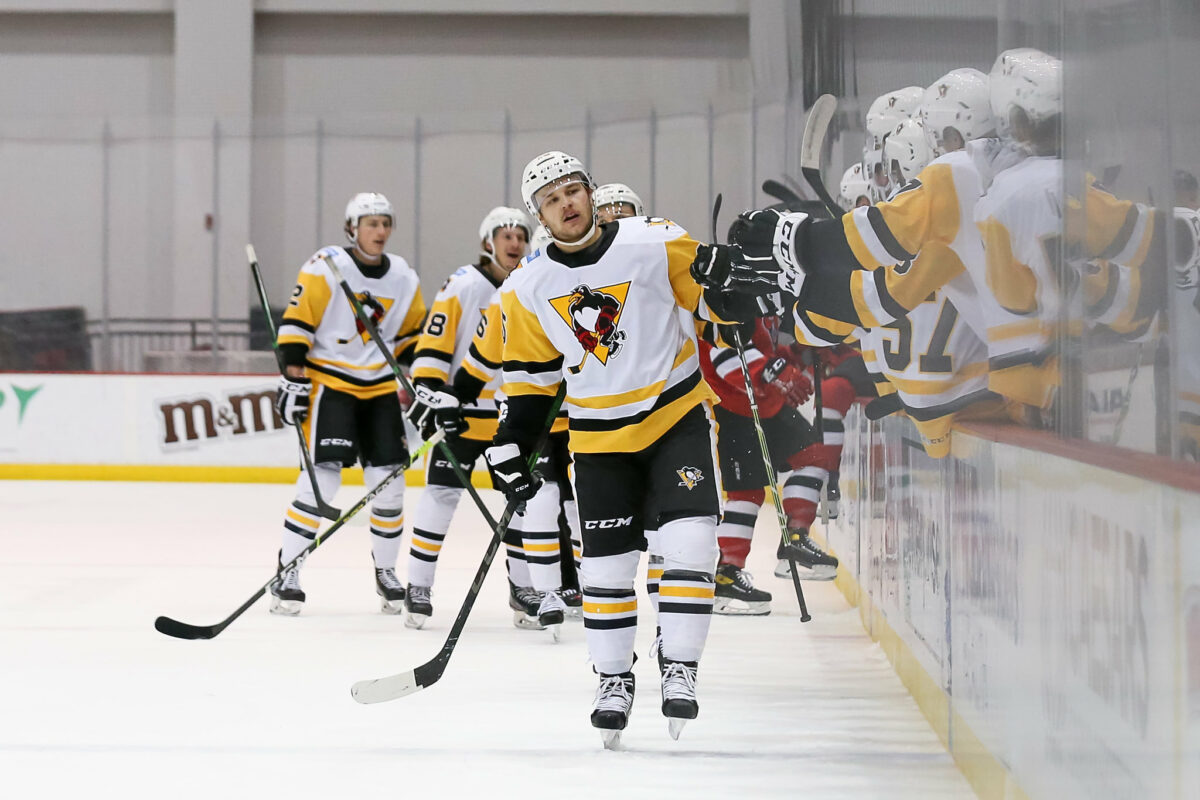
Fernstrom should also see enough opportunity to make the evaluation fair. Wilkes-Barre/Scranton will have several young forwards competing for offensive minutes, but the Penguins recalled him from Sweden specifically to bring his development closer to their staff. Keeping him buried on the fourth line would provide little information about whether the move worked.
A productive season would not require an immediate NHL promotion. Becoming a dependable top-nine AHL winger with consistent special-teams responsibility would restore much of the prospect value lost during his final months in Sweden.
Penguins’ Prospect Depth Raises the Pressure
Fernstrom is attempting to rebound inside a much stronger prospect pool than the one Pittsburgh had when it acquired him. Ben Kindel has already become an NHL contributor. Rutger McGroarty and Ville Koivunen are competing for permanent roles, while Bill Zonnon, Will Horcoff, Liam Ruck, Markus Ruck and several other recent draft picks give the organization additional forward depth at different developmental levels.
That progress is positive for Pittsburgh but creates urgency for Fernstrom. He cannot rely on his draft position or trade history to preserve his standing. The organization now has enough prospects that a player can move down the organizational hierarchy simply by remaining stationary while others improve.
The midseason Penguins prospect rankings already reflected the uncertainty surrounding Fernstrom after his difficult SHL start. His AHL production improved the outlook, but the injury prevented him from carrying that momentum through the postseason.
Fernstrom does have one advantage over many of Pittsburgh’s younger prospects. He has already played professional hockey in two different countries and shown that he can adjust quickly after a major midseason move. He is also signed through 2027-28, giving the Penguins time to continue working with him before making a final decision.
Time should not be confused with unlimited patience. Another inconsistent or injury-shortened year would allow younger players to move further ahead and could leave Fernstrom fighting merely to maintain a regular place in Wilkes-Barre/Scranton.
The Penguins’ prospect reset under Dubas depends on creating several NHL paths rather than placing every expectation on one or two top prospects. Fernstrom can still become one of those useful secondary options, but he must begin turning potential into a recognizable professional identity.
Fernstrom does not carry the entire value of the trade that sent Pettersson and O’Connor to Vancouver. The Penguins received two established NHL players, a first-round selection and Fernstrom. Desharnais was later traded for another draft pick, while Pittsburgh’s first-round draft maneuvering helped the organization add Zonnon and Horcoff. The return has already created several different branches of value.
Fernstrom can still make the trade look more complete. Pittsburgh had rated him highly during the 2024 Draft. His SHL rookie season explained that interest, while his AHL introduction showed why the organization has not given up after one disappointing year.
Pittsburgh does not need Fernstrom to become a star for the trade to work. Developing into an NHL depth scorer or a useful middle-six winger would provide meaningful additional value from a deal centered primarily on the first-round pick.
The concern is whether his strengths will become significant enough to overcome his limitations. Fernstrom has offensive awareness and a history of scoring, but he still needs more pace, consistency and effectiveness without the puck. His brief AHL run showed progress without proving that he can sustain it.
That is why 2026-27 is so important. Fernstrom is healthy enough to begin again, familiar with the North American game and old enough that the Penguins should expect a clearer answer. A strong season could restore him as one of Pittsburgh’s more interesting secondary prospects and establish a path toward an NHL opportunity. Another stalled year could leave him buried beneath the young forwards added since the Pettersson trade.
Fernstrom has already received one restart. His next season must show that it changed the direction of his development.
Free Newsletter
Get Pittsburgh Penguins coverage delivered to your inbox
In-depth analysis, breaking news, and insider takes – free.