2026 Canadiens Top 25 Under 25: Graduates and newcomers
Introduction
The Montreal Canadiens surprised everyone with a late-season run to just squeak into the playoffs in 2024-25, claiming their berth on the final day of the season. Last year, there was no such drama surrounding a playoff spot. A fairly weak schedule to begin the season allowed them to build an early cushion, helpful when some goaltending issues led to a poor month of November. They quickly worked around those to get back on track and won significantly more games than they lost the rest of the way to make the playoffs, and an eight-game winning streak through the end of March into April allowed them to do so as a seeded team in the Atlantic Division, with the sixth-best record in the NHL.
Montreal knocked off the two Atlantic teams that had finished above them, requiring seven games in each series. They arrived to the third round having played six more games than the Carolina Hurricanes, and after a commanding win in Game 1 their play rapidly declined in the subsequent matches as they lost the series in five games.
Despite the sudden end to the campaign, the Canadiens were one of the youngest teams ever to make it to the final four and proved that the Stanley Cup contention window is opening. With those new expectations, everyone assumed there would be another big trade from Kent Hughes, a feature of his tenure, but as we enter August, that move hasn’t come, leaving this year’s team looking largely the same as last year’s.
Montreal added eight new prospects to the pool via the draft when they probably expected to add only a handful. As a result, the Habs have made as many additions as there were subtractions over the past 12 months, so there are once again 55 players on the reserve list under the age of 25.
Graduates
| Player | DOB | 2025 | 2024 | 2023 | 2022 | 2021 | 2020 | 2019 |
|---|---|---|---|---|---|---|---|---|
| Cole Caufield | 2001-01-02 | 3 | 3 | 2 | 2 | 2 | 3 | 7 |
| Kirby Dach | 2001-01-21 | 10 | 4 | 3 | 5 | – | – | – |
| Alex Newhook | 2001-01-28 | 11 | 8 | 8 | – | – | – | – |
| Arber Xhekaj | 2001-01-30 | 12 | 14 | 17 | 21 | – | – | – |
| Jayden Struble | 2001-09-08 | 17 | 15 | 22 | 18 | 11 | 15 | 20 |
| Jakub Dobes | 2001-05-27 | 18 | 24 | 24 | 28 | 33 | 39 | – |
| Alexander Gordin | 2001-07-31 | 55 | 54 | 54 | 51 | 29 | 27 | – |
The number of players may be the same, but we did experience a drop in quality of the pool because we had one of the most significant graduating classes in the project’s history. Six members of last year’s Top 25 are still in the organization — still members of the Canadiens in fact — but are no longer eligible, as they have all turned 25 (or will before the cutoff date of September 15). Those six players who were first eligible for the 2019 NHL Draft are joined by one player who spent most of his time in the series at the opposite end of our list.
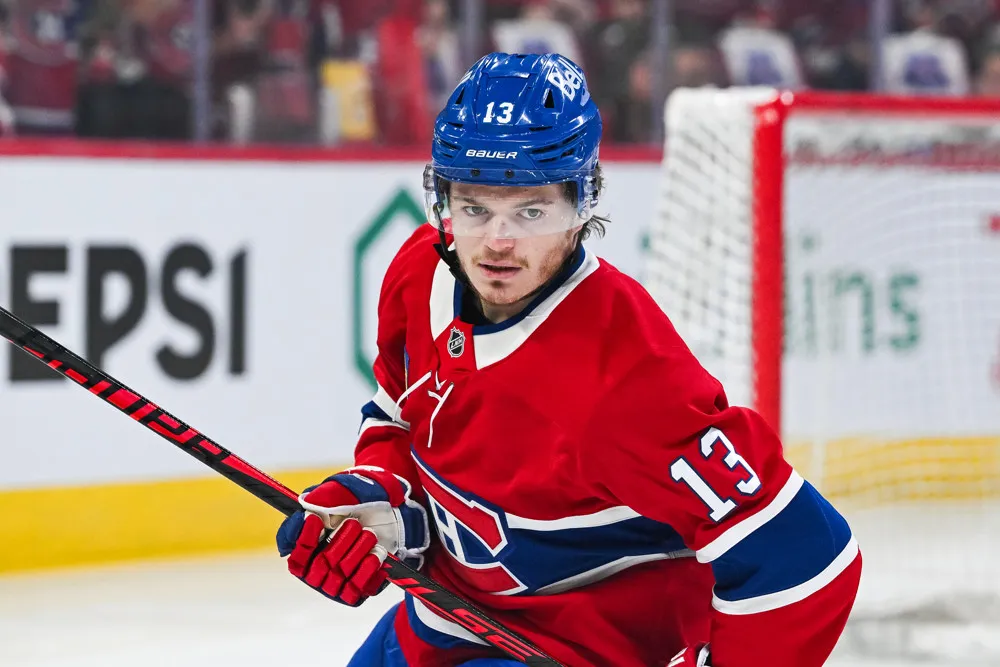
Cole Caufield
The biggest loss from last year’s ranking is Cole Caufield, who completed his seven years in the project last summer. In 2025, he ranked third in the order, and exits as one of the very best players we’ve ever profiled. He held an average position of 3.29, debuting at seventh and experiencing a three-year run at number two behind Nick Suzuki.
Caufield more than justified that lofty position last year by becoming the Canadiens’ first 50-goal-scorer since Stéphane Richer in 1989-90, accomplishing the feat with three games to spare and adding one more before the regular season came to a close. He also claimed an individual award for his efforts, with his joy for the game and exuberant support of his teammates helping him claim the Lady Byng Trophy.
But, we saw the Caufield infectious smile disappear through the playoffs and during the team’s locker clean-out. “I sucked,” he answered when asked how his playoffs went, in which he scored 13 points but just three at even strength and had a team-worst -10 rating. Each member of the top line expressed disappointment in their play in the season postmortem, so 2026-27 might be more about them developing playoff-ready habits than chasing milestones.
Kirby Dach
Kirby Dach was meant to be the team’s answer at second-line centre, filling a vacancy created when Phillip Danault ended up signing with the Los Angeles Kings following 2021’s run to the Stanley Cup Final. But his tenure with the Canadiens so far can best be summed up by the qualifying offer that came at the end of his four-year contract, one with a two-way structure because he didn’t meet the games-played thresholds to earn a deal that would guarantee NHL money.
In those four years, he played fewer than two full seasons’ worth of games, a total of 154. But he did play all 19 playoff games in the spring. He started off well with five points in 10 games, but was held off the scoresheet in the final nine, including all five games of the Eastern Conference Final.
Far from earning second-line-centre money, his new contract ended up being for one year and just $3.6 million dollars, 10% less than that two-way qualifying offer, and below the average contract for the current $104-million salary cap. Having turned 25 at the start of 2026, Dach graduates from the project still with a lot to prove.
Alex Newhook
The second big draft-day addition from Hughes after acquiring Dach the previous summer was Alex Newhook from the Colorado Avalanche. The reasoning was exactly the same: add an undervalued player who had the potential to become the missing piece at second-line centre.
It’s a role Newhook had a longer look in mostly because of the injuries that have plagued Dach over the entirety of his NHL career, though Newhook has dealt with concerns of his own. Three years later, neither player has been able to take that position, and last year it was rookie Oliver Kapanen who got the biggest opportunity there.
He may not be a second-line centre, but Newhook did establish himself as a quality second-line winger last year by contributing at a 50-point pace. His most memorable highlights were series-clinching goals in Game 7 of both the first and second rounds, and he ended the long playoff run as Montreal’s top goal-scorer. He was one of the Canadiens’ most improved players last season, and could take another offensive step playing opposite Ivan Demidov.
Arber Xhekaj
It wasn’t a career high in NHL games played for Arber Xhekaj in 2025-26, but he still got into 65 compared to the previous season’s 70, and also played 13 of Montreal’s 19 playoff games. None of those games came in the Eastern Conference Final versus the Carolina Hurricanes, and that has a lot of people wondering about his future with the team.
At this point, there’s no doubt about his ability to be an NHL defenceman (despite one game played at forward last season), and he would be an everyday player on just about any team other than Montreal with its seven quality blue-liners on the roster.
With the emergence of Lane Hutson and the addition of Noah Dobson, Xhekaj’s average ice time has continued to drop despite how often he draws into the lineup. The lowest expected-goal share of the blue-line corps last season didn’t help his case, and neither does a point total that has consistently dropped alongside his minutes.
David Reinbacher and Adam Engström are still waivers exempt, so there is no pressure on Xhekaj to lose a spot from that perspective. As things stand, #72 will still be with the team when the season begins in September.
Jayden Struble
It was a strong debut in the Top 25 Under 25 seven years ago for Jayden Struble as people recognized the NHL potential he had even coming out of high school. A solid frame and some offensive promise provided him several paths to making the Canadiens, and he projected as a bottom-pairing player at worst.
Now 25, Struble is an established NHLer, dressing for at least 56 games in the past three seasons, though he can’t quite claim to be an everyday player, and that’s mostly because of the player profiled above. Struble and Xhekaj have been vying for the same spot for three years now, and 2026-27 appears set to be a fourth.
Struble has had a bit of an edge on his friend Arber in the past couple of seasons because he’s shown the ability to complement Hutson and contribute a bit offensively in that role. However, it’s not the ideal situation, and each year that goes by sees right-shot defence prospects get closer to trying out for that coveted position. However that situation settles, Struble will continue to play in the NHL, whether in Montreal or with another club.
Jakub Dobeš
Last summer, his final one as a member of this series, Jakub Dobeš was a contentious player. Every panellist had him within the Top 25, but there was a divide between those who had him around 20th as a potential backup goaltender and others who saw a lot more in him. Twelve months later, it’s fair to say that those who envisioned more than a number-two role were right to hold him in high esteem.
As he did in December of 2024, his first starts of the season were very strong, but the struggles of Samuel Montembeault also seemed to affect Dobeš as both had a short period of poor performances. But while the media kept discussing the issues the Habs were having in net, Dobeš was steadily rising back to top form and took over the main starting duties as Montembeault never came out of his funk. Helping the Canadiens get to sixth in the NHL by the end of the season, Dobeš ended up fourth in Calder Trophy voting.
Now having turned 25 a couple of months ago, Dobeš is in the middle of his first off-season preparing to go into the season as the top netminder on the team. It’s amazing how far he’s come on both the technical and mental sides in his time in the organization, and he’s probably not done improving as a netminder.
Alexander Gordin
As fun (or stressful depending on your point of view) as it to rank the players at the very top of the list, there’s a certain comfort in having a few players that you could automatically drag to the bottom of your ballot and attack what has become a daunting list from both sides. For many participants, the player pulled right to the bottom of the ranking for several years was Alexander Gordin.
From the previous management regime that didn’t have nearly the same connections as the current group to evaluate Russian talent, Gordin is a top scoring talent whose game is seriously hampered by his skating ability. That has proven too great a limitation to even advance him from the Russian VHL to the KHL, a league that ranks below the AHL in terms of NHL equivalency in recent years. Stuck two or three levels below the NHL, it was tough to classify him as a “prospect” in the system, and his placement — dead last in each of the past three years — reflected his nil chance of becoming a member of the Canadiens.
Departures
Joshua Roy
Despite six departures from the organization, only two of the players had cracked the Top 25 last year. The top-ranked of them, both on last year’s list (20th) and in terms of all-time highest spot (seventh in 2022), was Joshua Roy. All five of his seasons as a Canadiens prospect were spent on the official list of this series, but he broke a streak of three consecutive years inside the top 10 by falling 11 spots in 2025.
Talent isn’t the issue with Roy. He showed great hand-eye coordination in his NHL games and had a promising quarter-season in 2023-24 in Montreal. He was quite steady in his minor-league production at just over 0.75 points per game in his three years. The issue was that those points always came in bursts, and the reason why he had stretches when he wasn’t producing is that he wasn’t engaged in the game. A point-per-game AHL scoring pace and a ticket back to the NHL were well within his reach, but he refused to grasp them.
The door isn’t shut on him playing at the top level, but he’s going to have to push through it on his own, especially in a new organization like the Utah Mammoth that doesn’t have nearly the level of investment.
Sean Farrell
If only Roy had Sean Farrell’s drive and determination. Farrell was one of the smaller players for the Rocket, but also one of its most consistent performers. He missed just five games in the past two seasons and his offensive totals were growing with those repetitions. He finished above Roy in points each of the last two years, and just six goals behind despite Roy’s stronger finishing skills.
Farrell has worked hard to overcome the limitations of his size, but he still had issues when going up physically versus AHL defencemen, often stopped in his tracks by a bigger body. He needed some space to work with, which he learned to find in Laval, but that remains a tough ask in the NHL.
As in Laval, he will need linemates to handle the physical play on his shifts to leave room for him to make plays. It’s a very specific complement of players he needs, tough enough to battle on the boards and skilled enough to take advantage of his playmaking, but perhaps he can find the combination in the Anaheim Ducks organization that allows him to take an NHL position.
William Trudeau
William Trudeau flirted with a spot inside the Top 25 for each of the five years he was a Canadiens prospect, always between positions 27 and 32. Each game he would have a moment or two that showed his potential, but he never developed those abilities into a consistent style of play.
Like most of the one-for-one trades made this summer, it was a change-of-scenery deal completed by the Canadiens and the New York Rangers. It gives Trudeau a new opportunity, and perhaps motivation, to find consistency and put himself in the conversation to play NHL games, something he wasn’t able to do among Montreal’s defensive depth.
Luke Tuch
Luch Tuch rose to 14th after 11 points in just 16 games to begin his time at Boston University. He fell out of the Top 25 when that rate didn’t repeat in his sophomore year, and he remained in the low 30s for the remainder of his time with the Canadiens.
Each of his AHL seasons ended with 14 points, though he played 24 more games last season to reach that total. He showed the work ethic and habits to carve out a professional career, but it seems unlikely that that will lead to consistent NHL time.
Laval Rocket general manager John Sedgwick made his first decision of the summer to send Tuch to the Columbus Blue Jackets, looking for someone with more of a chance of making it to the NHL in return.
Riley Kidney
A second-round selection in 2021, taken the pick before Montreal chose Kapanen, Riley Kidney debuted within the Top 25 that summer, and stayed in the teens for his first three seasons on the strength of 100- and 110-point seasons to end his QMJHL career.
He dropped several places when he struggled to carry that offence to the AHL, then fell further when his second year in the pros was less productive than his first. He played the majority of last season in the ECHL, and was traded to the Ottawa Senators in mid-March.
Ty Smilanic
Ty Smilanic originally joined the Canadiens organization when he was part of the package from the Florida Panthers for Ben Chiarot. After a good season with Quinnipiac University, he slotted in at 27th in this project in 2022. The next year, after transferring to Wisconsin, he revealed struggles with mental health, and played just 14 games in his junior season, netting two points.
He played with the ECHL’s Lions de Trois-Rivières in 2023-24, getting into 31 games and contributing seven points, but hasn’t played in a professional capacity since. In what would have been his final year of eligibility for this series, he’s no longer listed on Montreal’s reserve list, so it seems they no longer hold his rights despite the holding period being listed as “indefinite” for him, as it is for Russian prospects.
Newcomers
AHL swaps
Out went Tuch, Trudeau, Roy, and Farrell, and in came Hunter McKown, Brett Berard, Maksymilian Szuber, and Sasha Pastujov. Four players with low odds of making the NHL were dealt to new organizations, though the GMs on the other side probably had the same assessment of the players Montreal acquired.
We’ll see over the next year if Sedgwick and the pro scouting team just made lateral moves of if they found a player or two who can become a more effective player for the Rocket or, ideally, an option for the NHL team that none of the four players shipped out currently project to be.
2026 NHL Draft class
Everyone expected Hughes to trade away at least the 2026 first-round pick, and probably additional assets, to get more established players after Montreal’s playoff run. Instead, he found few takers at the draft, and ended up with eight new prospects in the system. They were mostly late-round picks in what is largely considered a weaker draft, so not of the same quality we had seen in the first few years of the tenure when the Canadiens finished near the bottom of the league.
The focus was on size even more than it was last year, and on over-age players who are closer to becoming pros, a reaction to Montreal being outmuscled in the playoffs and the management staff looking for players who can have short developments and bolster the current group in the near term.
Ethan Samson
In addition to the players brought in via trade, Montreal also signed a defencemen — one who shoots right, another trend from this off-season. Ethan Samson was a late-round pick of the Philadelphia Flyers in 2021, but was traded to the Tampa Bay Lightning last year before his ELC expired. He has only played AHL games to this point, and might see the situation on the right side of the defence in Montreal as a chance to change that.
Outlook
We won’t see such a strong graduating class in 2027, with just one current NHLer — Kaiden Guhle — in his final year. In total there are six players getting ranked for the last time, and half of those are from the AHL trades made this off-season. Either the vast majority of the top players and prospects will still be around a year from now, or there will be a major addition made to the lineup via trade in the meantime.
Montreal holds seven picks for the 2027 NHL Draft. A year ago, it was predicted that draft picks would mostly become currency now that the Canadiens were a perennial playoff team. That didn’t come to pass as few trades were made beyond the odd pick swap in 2026. It didn’t help Hughes’s case that Chicago Blackhawks general manager Kyle Davidson traded the fourth-overall pick to acquire Bowen Byram from Buffalo, and that had every GM with an NHL player to offer expecting a haul of top assets in exchange. We’ve heard about several players the Canadiens have been looking at, but the requested return is clearly too high to agree to the deal.
With the salary cap set to go up again next year, there won’t be many teams that need to move players out for financial reasons, so they can once again have high demands for their players. It could take several top assets to land the impact piece the GM is looking for under those market conditions. The best bet might be to wait until some separation occurs between teams during the season, and target some of the sellers trying to set new market prices.
We will be profiling the best players in the organization over the next several weeks. Tomorrow we’ll look at the players who are the furthest from reaching the NHL, those who ranked the lowest on our ballots this year.
If you would like to have your Top 25 Under 25 ballot sent to you, please leave a comment in the Introduction article for this season, linked below.