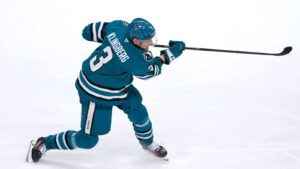
2026 Canadiens Top 25 Under 25: #3 Juraj Slafkovský

Introduction
“How many more tiers does Juraj Slafkovský still have before he reaches the peak of his powers?”
That is what we asked last year after a second consecutive 50-odd-point season cemented the Košičan as a cornerstone of the Montreal Canadiens’ forward corps. Well, we didn’t have to wait long to find out. In 2025-26, Slafkovský set new career bests in goals, assists, and points, becoming only the 10th member of the Canadiens to hit the 30-goal plateau in a single season since the turn of the millennium.
Further, tallying 28 of those 71 points before New Year’s answered a lot of questions about whether “second-half Slaf” could become “full-season Slaf,” while a considerable stint away from Nick Suzuki and Cole Caufield allayed fears that he was a one-line wonder.
Oh, and he put up eight points in six games at the 2026 Winter Olympics, guiding an under-strength Slovakia to a fourth-place finish.
Slafkovský’s season ended on a bit of a sour note as he (as well as Caufield and Suzuki) failed to really get going in the post-season in the way that they would have expected to. However, that just shows that despite making great leaps during the 2025-26 campaign, Montreal’s top power forward is still capable of much, much more.
Voting

The panel was almost unanimous, with eight of nine voters placing Slafkovský in third place.

The community members were almost as unified, with Slafkovský third on 75% of ballots cast.
Top 25 Under 25 History

Slafkovský returns to the ranking that he held when he was first drafted, gaining one place over his ranking last season.
History of #3
| Year | #3 |
|---|---|
| 2026 | Juraj Slafkovský |
| 2025 | Cole Caufield |
| 2024 | Cole Caufield |
| 2023 | Kirby Dach |
| 2022 | Juraj Slafkovský |
| 2021 | Alexander Romanov |
| 2020 | Cole Caufield |
| 2019 | Jonathan Drouin |
| 2018 | Artturi Lehkonen |
| 2017 | Artturi Lehkonen |
| 2016 | Mikhail Sergachev |
| 2015 | Nathan Beaulieu |
| 2014 | Nathan Beaulieu |
| 2013 | Max Pacioretty |
| 2012 | Alex Galchenyuk |
| 2011 | Max Pacioretty |
| 2010 | Lars Eller |
Strengths
Slafkovský’s greatest strength, and the thing that sets him apart within the Canadiens’ roster, is his unique combination of size and skill. In the past, we’ve lauded his playmaking and vision. Last year, we saw him add a newfound assertiveness and confidence in his shot to go with it, making him a more multifaceted weapon. Reassuringly, most of Slafkovský’s goals came from either the high slot or the right point, showcasing his willingness to both go to the hard areas and an ability to find quiet space.
Now, the Canadiens have a player who can roll off the boards into the centre of the ice, shielding the puck with his body, and then go top shelf:
Who can quietly drift into open space under time constraints:
Or camp in the slot to rip home a one-time pass from behind the net:
Slafkovský’s emergence as a more legitimate goal-scoring threat, combined with his already established board-battle prowess and playmaking capabilities, makes him a valuable all-around player who can theoretically assert himself on any line. This isn’t just a theoretical statement: the Slovak forward played major five-on-five minutes augmenting both the Caufield-Suzuki and Oliver Kapanen-Ivan Demidov duos.

Weaknesses
Watching Slafkovský, it can be difficult at times to remember that he is a mere 22 years of age, and was the second-youngest player on the Canadiens’ 2025-26 opening-day roster. Thus, the fact that he remains far from a finished product shouldn’t be surprising. His main issue at this point lies in how he manages his energies and capabilities. The winger clearly fatigued as both the Olympics and the playoffs went on, which impacted his ability to impose himself on the game and his decision-making on the ice.
No matter what movies and coaches will claim, no player can go full-gas for every minute of every game. Slafkovský’s priority moving forward will be to figure out how to best budget his efforts. Some of this will come with time, as physical endurance naturally improves with age. Some of this will come with experience as he navigates more and more on-ice situations, both as just a player and as a play-driver. As this process continues its due course, we should hopefully see more efficient decisions and fewer blind cross-ice passes to exit the defensive zone.
Ultimately, Slafkovský needs to identify the moments — maybe as little as a single shift — where he can take over for maximum benefit. This is already taking shape to some extent: his four game-winning-goals last season were good for a share of second on the team with Demidov. But it doesn’t have to manifest on the scoreboard. Sometimes, a 60-second shift, where he uses his size for leverage and simply cycles the puck in the offensive zone to shift the momentum or put the opposition on their heels, can dictate the course of a match.
Projection
The question we asked last year is the same one we’ll ask again this year. Although Slafkovský has clearly improved by leaps and bounds, he also just as clearly has yet to reach his full potential. Unlike some of the other players in this year’s Top 25 Under 25, Slafkovský’s skill set has been largely established. The main goal now is to help the 2022 first-overall selection refine his game, to do what he does more efficiently, more effectively, and better in general.
Once upon a time, uttering Mikko Rantanen’s name as a comparable player would have elicited derisive laughter. After the 2025-26 season, the rest of the league isn’t laughing anymore.