2025-26 Awards Predictions — The Fourth Period
With the 2025-26 NHL regular-season now complete (spring is here!), it’s time for awards and playoff predictions.
The awards will be a mixture of the ole’ eye test (one of them is 20-10! The other… ehh) and Dave’s favourite gal, Annielytics, making her return.
Lots of popcorn fodder here, so let’s jump right in:
Coach of the Year
As good as they were for his first 20 or so games, I was never on the Rick Bowness for the Jack Adams train. He simply wasn’t there long enough. And when that train got derailed the past few weeks, that made the decision that much easier. Rod Brind’Amour and Travis Green (who ironically are facing each other in the first round of the playoffs) deserve some love here, as does Tampa Bay’s Jon Cooper and Philadelphia’s Rick Tocchet. Which brings up an interesting question you might be asking yourself:
Why does one Pennsylvania-based HC get a nom and the other doesn’t, even though both guided what looked like non-playoff teams into playoff berths (where again, they’ll play each other)? Because, Sidney Crosby aside, Tocchet had more depth to work with. No one thought the Flyers would be in the race for the 1st overall draft pick this June, whereas it felt like Pittsburgh was basically the only team guaranteed to be, trying to sell in the summer, clearly rebuilding, yet here they are, one of the best stories of the season.
Bednar is here because his Avs won the President’s Trophy as the best regular-season team and fought through many injuries to lead the league in points, goal differential (a staggering +99), among several categories.
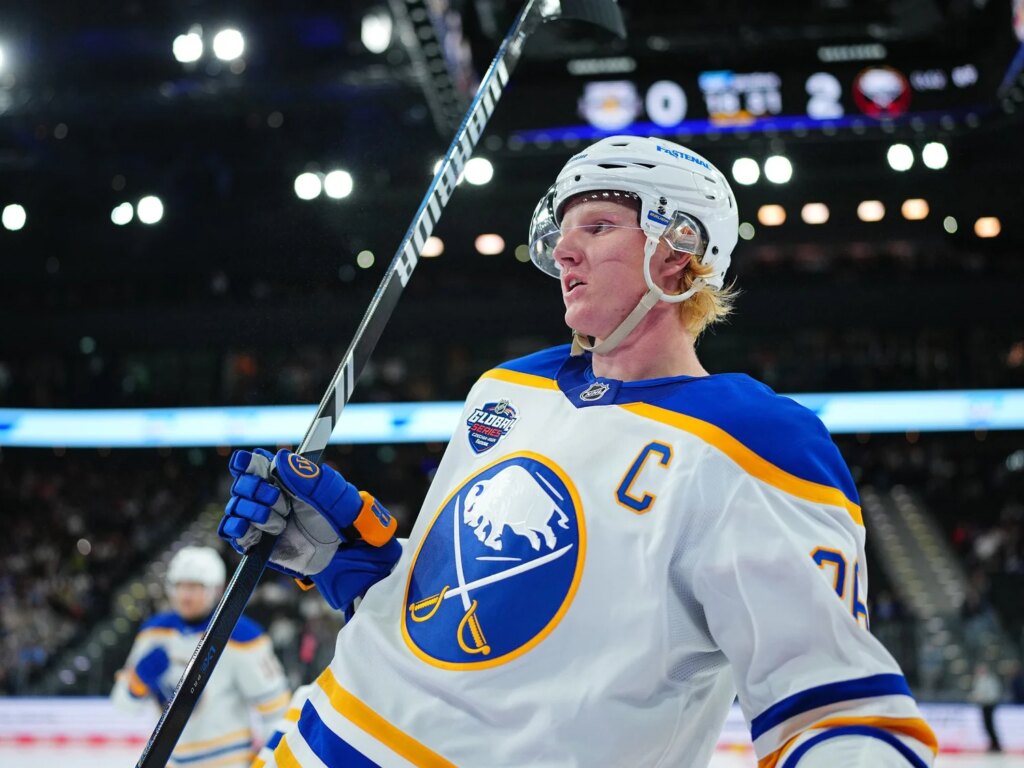
Maybe the best story though belongs in Buffalo, where they flipped a switch early winter and decided to play to their collective potential, the sum of the parts creating a nigh-unstoppable whole.
The best story doesn’t automatically get you the W here, as my winner for Coach of the Year is Dan Muse.
Muse came in out of nowhere, most recently an assistant coach with the floundering New York Rangers, implemented a strong defensive structure while allowing his offensive players (both forwards and defensemen alike) to play their games, brought the most obvious non-contending team into the playoffs, gave Erik Karlsson a partner (Parker Wotherspoon) who allowed Karlsson to return to his Norris-level form (a spoiler for later? Perhaps…) and made one of the smartest moves of any head coach this year: he finally, finally put Evgeni Malkin on the wing. The result? 19-42-61 in 56 games, his first point-per-game season in three years. His advanced stats are strong (though on Puckpedia they look a little better), and to top it off, he did this. 100% chance Pittsburgh should re-sign him, and let the best new head coach in the league continue to maximize everything Gino has left.
Now, since Buffalo is the flashiest story, some of you are surely asking “Why not Lindy?” Three reasons. First, Josh Norris returned to the lineup on December 1, solidifying Buffalo’s top-6 center depth, and scored points in all but three games in December. Second, pretty much the second that Kevyn Adams was fired as General Manager in Buffalo, the team turned things around. You’d have thought that Norris came back on December 15, when Adams was fired. Specifically, Buffalo won the night before, Adams was fired anyway, and then Buffalo steamrolled the league for the rest of December, winning all seven remaining games that month, and they were off.
Third, well, let’s go to the Norris Trophy discussion, and we’ll pick up the final reason there.
Defenseman of the Year:
-
Moritz Seider, Detroit
-
Cale Makar, Colorado
-
Rasmus Dahlin, Buffalo
This is like a 15-player race. Zach Werenski isn’t even in my personal top-3, yet he’s a joy to watch and he may well win this year (though The Columbus Collapse may put a stop to that). Quinn Hughes was transformational in the 48 games he played for Minnesota this season, putting up 5-48-53 and levelling the Wild up into true Stanley Cup contenders, even sans a legit 1st line center (the other 26 games in Vancouver though…). The aforementioned Erik Karlsson had one of the best seasons of his career, playing shutdown minutes on D and driving Pittsburgh’s offense on the other side. Jake Sanderson, Darren Raddysh, I could go on and on.
So why these three players? Well, Makar did Makar things, playing a stronger 200-foot game than Karlsson, playing steady defense and tornado-esque offense. One second, he’s on his off-wing, skating the puck all over the offensive zone. The next second, he passes to Nathan MacKinnon and darts back to his side of the ice, where he then streaks toward the net for MacKinnon to hit him with a cross-ice pass at the top of the circle, where he (“oh jeez, blocker side”) scores on his patented mid-to-high blocker wrist shot (man those shots were fun as a kid). Over and over, in the NHL, even in the Olympics, Makar was as unstoppable from the top of the right circle in as ever this season.
Seider, well he went full unicorn this year. After years of being dragged down by Ben Chiarot, who somehow got a three-year contract extension after this level of play (don’t ever wonder why Detroit can’t make the playoffs, Chiarot is a one-man anchor), Seider was mercifully paired up with top young defenseman Simon Edvinsson, which allowed Seider to play to his potential. Seider was the 9th best defensive D-man this season, and to my eyes meant more to Detroit than the only two-way defenseman ahead of him on that list (Jake Sanderson, and yes I know it’s close). The fact that what he meant to Detroit should get him some down-ballot Hart Trophy votes (by definition, he fits), that puts him on this list for me.
Now, that third piece of the Buffalo puzzle, the one that we don’t have as much direct insight to, though we can surmise based on the emotion involved and the end result. Rasmus Dahlin’s fiancée had considerable health issues in the summer and early in the season, to the point where Buffalo’s Captain left the team to spend time with her, to be there for her. Without having a stall in the dressing room, you know the impact of losing a player like that somewhat by how the team does in his absence (though The Ewing Theory can come into play here), but more so by what happens when he returns. When Dahlin returned to the lineup after missing several games, Buffalo won four of the next five games, and that was a month before Adams was dismissed.
Dahlin, this week won the Rick Martin Memorial Award, “presented annually to a Sabres player who demonstrates on-ice excellence, resilience and dedication to the community.” And today, he wins my Defenseman of the Year Award. A career high in points and +/-, 5th in goals by a D, 6th in points, 19-55-74 in 77 games played, though it goes beyond those things. Dahlin, in the midst of a life-threatening situation for his fiancée, galvanized his team, led them on and off the ice, and absolutely shattered the narrative around Buffalo. The team that could never quite get there steamrolled the NHL from December 14 on, to the tune of a 50-win season and overtaking the dominant, top Stanley Cup contenders in Tampa Bay for 1st place in the Atlantic Division and 2nd overall in the Eastern Conference. Dahlin took care of his family off the ice, and he took care of his family on the ice. A man handles his business, and Rasmus Dahlin was The Man among D-men this season.
Best Podcaster:
-
Ray Ferraro
-
Elliotte Friedman
-
Jeff Marek
If you’ve read my work this year or in the past, you know I’m a Marek guy through and through, and certainly am going to get the invite onto his show any day now. His historical knowledge, the obscure-yet-logical thoughts he comes up with, and his passion for hockey make him a must-listen. Friedman’s work ethic to track down inside information is second-to-none, and it shows in the sheer volume of information he supplies twice a week. Both are entertaining, and figured out how to thrive without one another.
My pick, though, is Ray Ferraro. Intensity: Check. Focus: Check. Game Knowledge: Check. We all have more that we can learn about hockey, and for me, the only, the singular podcaster who makes me smarter about the game of hockey is Ray Ferraro. The fact that he does so in an entertaining way makes it all the better. He’s a workhorse in his own right, travelling near-constantly for different broadcasts, while also doing the Ray & Dregs show (with Darren Dreger) twice a week. When Ray sits us under the learning tree, it’s as good as it gets for a hockey podcaster (who isn’t breaking news or giving us behind the scenes play-by-play).
Goaltender of the Year
-
Ilya Sorokin, NYI
-
Logan Thompson, Washington
-
Jeremy Swayman, Boston
-
Dan Vladar, Philadelphia
-
Igor Shesterkin, NYR
-
Scott Wedgewood, Colorado
-
Andrei Vasilevskiy, Tampa Bay
On one hand, it’s not easy to watch enough games of every team in the NHL to see their starting goalie play enough times to generate a real opinion on their level of play from the start of the regular season to the end. On the other hand, it’s way too easy to simply look at stats – Wins, GAA, and SV% for the counting stats crowd, or GVAx (goals saved above expected, the stat that should redefine how goalies are measured – until the next fancy stat comes out) for Annie’s crew. So, let’s dig deeper.
Twenty five goalies played 45 games or more, so we’ll focus on them as the true #1/1A on their respective teams. The focus here is on top candidates, names being pushed in the media, and one dark horse who…wedged his way into the conversation.
Wins
1. Andrei Vasilevskiy, TB, 39 in 58 games
5. Scott Wedgewood, Col., 31 in 45 games
6. Jeremy Swayman, Bos., 31 in 55 games
7. Logan Thompson, Wash., 31 in 58 games
10. Dan Vladar, Phili, 29 in 52 games
11. Ilya Sorokin, NYI, 29 in 55 games
18. Igor Shesterkin, NYR, 25 in 51 games
GAA
1. Wedgewood, 2.02 in 45 games
2. Vasilevskiy, 2.31 in 58 games
3. Vladar, 2.42 in 52 games
5. Thompson. 2.44 in 58 games
7. Shesterkin, 2.50 in 51 games
18. Sorokin, 2.68 in 55 games
22. Swayman, 2.71 in 55 games
SV%
1. Scott Wedgewood, Col., .921
2. Logan Thompson, Wash., .912
3. Igor Shesterkin, NYR, .912 (Thompson was .0002 higher)
4. Andrei Vasilevskiy, TB, .911
7. Jeremy Swayman, Bos., .907
8. Ilya Sorokin, NYI, .906
9. Dan Vladar, Phili, .906 (Sorokin was .0002 higher)
MoneyPuck GSAx
1. Thompson, 29.3 in 58 games
2. Swayman, 28.8 in 55 games
3. Sorokin, 25.3 in 55 games
4. Vasilevskiy, 24.7 in 58 games
5. Wedgewood, 23.1 in 45 games
6. Shesterkin, 21.3 in 51 games
8. Vladar: 13.8 in 52 games
Statpede GSAx
1. Thompson, 49.88 in 58 games
2. Swayman, 40.65 in 55 games
3. Sorokin, 39.73 in 55 games
4. Vasilevskiy, 34.37 in 58 games
5. Shesterkin, 29.57 in 58 games
6. Wedgewood, 29.53 in 45 games
11. Vladar, 19.14 in 52 games
DZF (Defensive Zone Faceoffs)
Vasilevskiy: 557 (3rd in the league)
Thompson: 510 (8th)
Vladar: 478 (12th)
Sorokin: 469 (13th)
Swayman: 456 (15th)
Wedgewood: 427 (18th)
Shesterkin: 395 (23rd)
Where it gets even more interesting is when you look at something like GSAx at 5-on-4. When their teams had powerplays, Vladar (14th, -0.7) Shesterkin (16th, -1.0), Swayman (19th, -1.9), Sorokin (22st, -2.3), Wedgewood (24th, -3.7), and Thompson (25th/last of all goalies who played 45 or more games, -3.9) all gave up too many short-handed goals. How much of that is on them vs is a product of the team in front of them? Either way, wild to see these guys at the bottom here. (If you’re wondering, Vasikevskiy was 4th with 1.9 GSAx at 5-on-4.)
Natural Stat Trick jumped in with High Danger plays, where Sorokin faced the most high-danger shots against, Thompson was 3rd, Swayman 7th, and Vasilevskiy 10th. Swayman had the best high danger SV% of any goalie playing 45 or more games, with Sorokin 2nd, Shesterkin 5th, Vladar 6th, Wedgewood 7th, Thompson 8th, and Vasilevskiy 9th
Scott Wedgewood (!!!!!) dominated the counting stat categories and was top-5 in wins despite only playing 45 games. Thompson stopped the most puck that should have gone in, though on MoneyPuck, Swayman stopped more per 60 minutes than Thompson, while on Statmuse Thompson was clearly ahead per 60. Vasilevskiy faced the most set play pressure, with Thompson 2nd among the top goalies. Sorokin and Swayman were the most, and the best, under siege.
Can this be a five-way tie? No? Okay.
In that case, we’re heading to Washington, via Brock University, where Logan Thompson is my top goaltender this year. On a non-playoff team, he was T-4 for most wins (drops to 7th based on games played tiebreaker), faced the 3rd most shots in the NHL (and most of the seven finalists) yet had the 2nd best save percentage (with the 3rd most saves), faced the third most high-danger plays and was top-10 in keeping them out of the net (your team’s ability or lack thereof to clear rebounds and get the puck out of the zone plays a part here, and he was on a losing team), and Thompson flat-out stopped the most pucks that should have gone in out of every goalie in the league. It’s not an easy call, and you can very much make a case for (in alphabetical order) Sorokin, Swayman, and Wedgewood. Thompson did a little bit extra for me though, and is deserving of this award. We’ll always wonder what he could have done in Milan.
Rookie of the Year
I’m not even bothering. Matthew Schaefer was a beast. Playing a full 82-game season as an 18 year old after missing most of his draft year due to injury, 23-36-59 in those 82 games, positive defensive metrics, played 24:41 per game, only 38 penalty minutes (I never saw him in a fight and assuming there’s no 10-minute misconducts there, he only took 19 penalties in 82 games, which tells you he was not chasing the game very often). Based on his play alone, Schaefer should have been on Team Canada at the Olympics (the age, I know), and will definitely get some down-ballot Norris Trophy votes. Huge credit to Patrick Roy, who has a history of getting the most out of young players (and deserves to be coaching in the NHL) and developed Schaefer incredibly well. As good as Ivan Demidov was this year, this is a one-player race.
Hart Trophy
Player of the Year
1. Connor McDavid
2. Nathan MacKinnon
3. Nikita Kucherov
4. Macklin Celebrini
5. Cale Makar
If I may be random for a moment, Sam Malinski, who came into this, his second full NHL season, as a 5’11”, 3rd pairing RD for Colorado, finished as the 7th highest rated player in the NHL this year according to Hockey Stat Cards. 8-32-40 in 82 games (somehow, playing behind Makar he put up numbers), an average game score of 1.57 (that’s what Auston Matthews was doing in his MVP era), and averaged 1.66 expected goals for vs every one goal against (and the actuals were over 2-1). Wild. No, this does not mean his team carried him, or these rankings would be littered with 3rd line forwards and 3rd pair D mixed among the top players. It means that he can play. Mostly.
The only reason he’s not getting any buzz is that he played 17:37 per game, and his quality of competition was very 3rd line (hence the “mostly”). If he can keep even close to this level up in the playoffs, should Brent Burns get tired come April/May (always my concern when the Avs signed him), then you can shelter Burns on a 3rd pair and elevate Malinski, as playing like the 4th best defenseman in the entire NHL during the regular season should mean you can successfully win your minutes against 2nd lines in the playoffs.
Now that all our respective brains have melted…
I have Makar listed as he’s my 5th place vote. Great year, great metrics, but not his best.
I’ve grouped the NHL’s version of the best player award with my version because, well, keep reading. We’ll start with the Player of the Year award.
Early in the season, it was Nate MacKinnon. Then in late-November when the “Maybe MacKinnon has surpassed McDavid” talk began, McDavid put up 31 points in 11 games from December 4-23, and has been full Juggernaut ever since.
Later in the season, as he so often does, Nikita Kucherov entered the chat. 51 points in 23 games from January 16-March 22 led to Kucherov almost catching McDavid for the Art Ross Trophy.
MacKinnon won the Rocket Richard Trophy for most goals with 53.
McDavid won the Art Ross Trophy for most points with 138, his second-highest total ever. He also led the league with 90 assists in 82 games, four more than Kucherov’s 86, giving him second place.
As far as points per game goes, Kucherov, with 1.71 points per game edges out McDavid’s 1.68. Both played without key linemates at different times this season, and one could make the, ahem, point, that once Brayden Point started playing to his level, that’s when Kucherov’s season took off, which the timeline supports.
Where this separates for me is that MacKinnon was in the 89th percentile among defensive players (part of the reason why Wedgewood had such a strong season), while Kucherov was in the 57th percentile (a -0.2) and McDavid in the 22nd percentile with a -1.7 that one can argue has to do with the team around him, and they’d have a point, but still.
My NHL Player of the Year: Nathan MacKinnon.
The Hart Discussion
The NHL badly needs to either redefine the Hart Trophy, which is given “to the player adjudged to be the most valuable to his team”, or add in a best overall player award, and open it up equally to forwards, defensemen, and goalies alike.
On the Hart side, of course the best players are going to be incredibly valuable to their team, which is why they’re all here. You could easily throw in the aforementioned Moritz Seider in Detroit, Zach Werenski in Columbus, Dan Vladar in Phili – any number of top players on weaker teams fit the Hart Trophy definition and in that discussion.
What I’m looking at is pretty simple: If you removed player X from his team, how much would it affect them? In Colorado, while MacKinnon was 2nd among all NHL forwards in ice time and Makar 7th among all D, the fact that you could take them both off that team and they’re still going to be ahead of 8-10 teams in the league is enough to remove them from my Hart rankings. Same with Kucherov in Tampa Bay, they’re still a playoff team without him, especially with their improved defense this year.
Edmonton gets a little dicey, as the Oilers simply do not have the depth (or goaltending) of years past. On paper they should, however that team has been playing tired all year. Had it not been for the tremendous seasons from McDavid, Leon Draisaitl (97 points in 65 games, he’d have been here had he not been injured), and defenseman scoring leader Evan Bouchard, Edmonton would have been worse than Florida this year. Remove McDavid, the NHL’s leading scorer who also led all forwards in ice time per game from Edmonton this year, and it’s a hard winter in Oil Country. He’s a contender.
This brings us to the new kid. MACKLIN. 4th in the NHL in scoring, and without much support. Let’s make a strong and to me, obvious statement to start: If Celebrini was removed from the San Jose roster this year, the Sharks are not only the worst team in the NHL, they may not even be the best team in the AHL. That means something.
As it was a stat introduced to me in the 90s, I’ve been tracking the percentage of San Jose’s goals Celebrini was in on vs the total number of goals San Jose scored.
Celebrini: 45-70-115
San Jose: 251 goals
Celebrini was in on 45.8% of all San Jose goals this year. Now, yes, McDavid was in on 48.9% of all Edmonton’s goals, so we look deeper. Who were they surrounded by?
In Edmonton, McDavid had the likes of Draisaitl, Bouchard, Ryan Nugent-Hopkins (20-36-56 in 72 games), and for 58 games, Zach Hyman (31-21-52). He also played a fair amount with Jack Roslovic (21-15-36 in 69 games) and Matthew Savoie, who had 19 of his 37 points this year in 24 games (65-point pace per 82 games) after joining McDavid’s line post-Olympics.
In San Jose, Celebrini had Will Smith (24-35-59 in 69 games), Collin Graf was a fairly regular linemate (21-25-46 in 81 games), along with some Tyler Toffoli (19-30-49 in 79 games, a clear sign that they did not play together a lot as Toffoli would have put up 30 if he’d been with Celebrini all year), and William Eklund (15-38-53 in 78 games, again a player I never saw playing with Celebrini at 5-on-5). Dmitry Orlov was their top scoring D-man with 3-34-37 in 82 games. (Alexander Wennberg centered a different line.)
Draisaitl and Bouchard almost out-pointed the listed San Jose players by themselves. Draisaitl and Hyman missed a combined 41 games, while Smith missed 13 games and Celebrini spent much of the year with Graf, an unsigned college free agent, on his wing, instead of a Toffoli or an Eklund (guys he’d see more on the PP). Celebrini also did not have the defensive support that McDavid did. Both players are capable of rushing the puck into the zone, however Edmonton’s 5-man unit gave McDavid a better chance of keeping the puck there and putting sustained pressure on the opposing team.
Also, I absolutely, positively, eleventy billion percent do not care that San Jose did not make the playoffs. The idea that one player, superstar or not, is expected to elevate a team with this roster into the playoffs or else is a ridiculous standard to hold anyone to. San Jose GM Mike Grier had the opportunity to attack at the trade deadline, to bring in reinforcements, as I hoped he would. Whether he didn’t try to, or he suffered from Trelivingitis, Grier didn’t make San Jose demonstratively stronger post-March 6. For San Jose to have finished 9th in the conference, 4 points out of a tie with LA (where they would have won the tiebreaker based on more wins) with that team, is very much akin to what early Mario Lemieux did with some really weak Penguins teams of the late-80s. Playoffs or not, my Hart Trophy goes to Macklin Celebrini.