Why Adam Engström’s smooth, steady play is a dilemma for the Canadiens
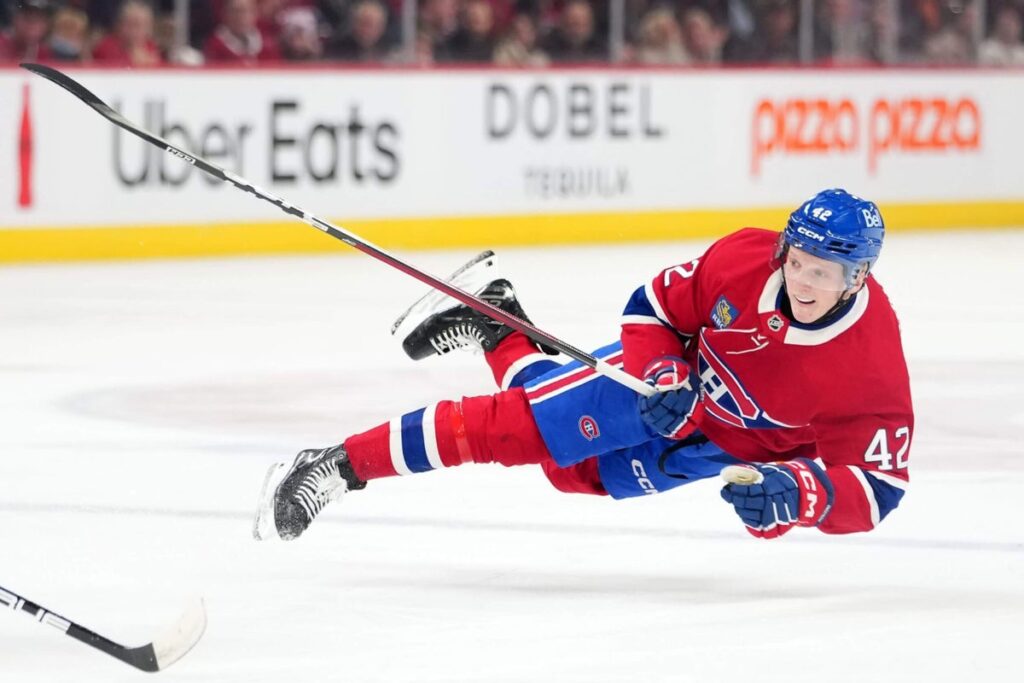
MONTREAL — The Philadelphia Flyers had something to be excited about Tuesday morning.
For the first time since March, they would have the big, physical, mobile Rasmus Ristolainen, who brings everything you want from a traditional defenceman, in their lineup.
On his fourth shift of the season, Ristolainen was patrolling the neutral zone when 22-year-old Montreal Canadiens rookie Adam Engström began a breakout from behind his own net. He skated the puck out, saw Juraj Slafkovský in the neutral zone and hit him with a pass. Slafkovský was immediately leveled by Ristolainen, which is what the Flyers have missed as he recovered from surgery to a triceps tendon. Canadiens rookie Ivan Demidov, 19, went after Ristolainen, cross-checking him in retaliation and taking a penalty the team was surely fine with because it showed a competitive spirit from a young player.
BACK WITH A BANG. 💥#PHIvsMTL | #LetsGoFlyers pic.twitter.com/YWt6rMikPj
— Philadelphia Flyers (@NHLFlyers) December 17, 2025
The Canadiens lost, 4-1. They played a good game and were done in by three errors — or bounces, depending on your point of view — that wound up in their net. They dominated the entire third period, but had trouble penetrating the Flyers’ collapsing defence.
It was, as coach Martin St. Louis called it, a mature game, which is all the Canadiens are after. They are a young team, and sometimes when you lose a mature game, that’s more important than the result.
But the play where Ristolainen blew up Slafkovský off a pass from Engström symbolized something of greater importance for the Canadiens.
Essentially, does their defence need more players like Ristolainen? Or do they need more players like Engström?
Consider this a long-term thought exercise more than a short-term game report.
The Canadiens were missing Mike Matheson, who is 10th in the NHL in ice time and second in shorthanded ice time per game, faces top opposition and plays the most difficult minutes on the team.
Matheson does so by leaning on his mobility more than his physicality. The same is true of his usual defence partner Noah Dobson, as well as Lane Hutson, Alexandre Carrier and David Reinbacher, who is in AHL Laval and preparing to join the Canadiens. And the same is true of Engström.
In Matheson’s absence, Engström played a career-high 15:45 and displayed what has allowed him to excel in Laval. The mobility, the smarts, the reads, all of it looks NHL-calibre.
NHL GameScore Impact Card for Montreal Canadiens on 2025-12-16: pic.twitter.com/vAUdhugWun
— HockeyStatCards (@hockeystatcards) December 17, 2025
The way Engström plays is somewhat reminiscent of a less-refined version of Matheson.
“Yeah, they’re pretty similar,” Hutson said before the game Tuesday morning, “the way they skate, the way they move and the way they defend, hard on pucks, hard in the corners.”
But it also looks like more of the same for the Canadiens. Matheson, Dobson and Hutson are all under contract long-term and they hope Reinbacher will be as well. Can a team double-down on mobility as the defining quality of its blue line and hope to have success in the playoffs?
Engström’s defence partner, Arber Xhekaj, is supposed to represent the counterbalance to that, as is Jayden Struble and, most importantly, the injured Kaiden Guhle, who is also locked up long-term.
In a vacuum, Engström is an extremely appealing defence prospect.
“Obviously he’s a great skater,” St. Louis said after the game. “I just think he plays the game that’s in front of him. I don’t think he’s intimidated by the NHL, I just think he plays the game. I think he’s a confident kid, he can do a lot on the ice. I think the fact he just plays the game, he shows you his abilities a lot just because he doesn’t seem too worried out there. He’s just playing hockey. The players who do that at this stage of their (development), obviously they have a lot of tools, but they have a confidence behind the tools. I think he’s showing that.”
In the Canadiens’ context, however, there is a mix of physicality and mobility that would be ideal on the blue line. Based on the players they have already committed to, it is worth wondering how Engström can help create the proper mix over the long haul.
Getting a player like this with the No. 92 pick in the 2022 draft — this administration’s first in a draft that also landed them Slafkovský, Hutson, Owen Beck and Jared Davidson, who are all on the roster – is a massive coup.
But can mobility be the defining characteristic of an NHL blue line when the games matter most, in the playoffs? That might be a question for a later date, but it appears to be very pertinent to Engström’s future in the organization. It has long been believed you need a big, rugged defence to win in the playoffs, something this organization used in reaching the Stanley Cup Final in 2021 with a blue line that leaned heavily on Shea Weber, Ben Chiarot, Joel Edmundson and Jeff Petry in the top-four.
However, it could be argued the Florida Panthers have done it in back-to-back years, with the only defencemen really defined by physicality being Aaron Ekblad and Niko Mikkola. Their best defender is inarguably Gustav Forsling, who defends primarily with his feet.
“To me, you put yourself in position to kill plays with your feet,” St. Louis said Tuesday morning. “And then some guys are better equipped (to kill a play) once they use their feet. Like, I’ll give you an example, Lane will use his feet to get there. He might kill it differently once he gets there than Matheson or Xhekaj or Strubes.
“But having the feet to put yourself in those positions is big.”
Hockey is constantly evolving, and the key for any team is to be ahead of that evolution and adapt to it before everyone else, as opposed to clinging to how things worked in the past. It is this philosophy that allowed the Canadiens to draft Hutson at the end of the second round in 2022, because they were willing to overlook his size and saw potential in his brain and feet and competitive nature. And perhaps it is this philosophy that might allow Engström to have room on this team despite so many other defencemen sharing a similar profile.
“I feel like when you can skate and you can get pucks and win races, you have a pretty good advantage of having the puck more often than not,” Hutson said Tuesday morning. “There’s obviously bigger guys who maybe don’t move as well, they might lose a couple of more races and maybe we miss a chance to throw an extra hit or whatever. But I think it balances itself out.
“I think we’ve got a good group for winning those races and getting those pucks back quick.”
Hutson was dominant, as he often is, against the Flyers. The Canadiens had 29 of their 48 shot attempts at five-on-five with him on the ice. But his central, long-term presence on their blue line has led to an assumption that they need to offset him with size and toughness.
But what if that’s not true? What if the answer is doubling down on the mobile nature of the Canadiens’ blue line? What if what worked in the playoffs in the past is not necessarily what will work in the playoffs in the future?
It’s a dilemma, and perhaps even a tipping point for the Canadiens. They clearly have a very promising talent in Engström, one that can benefit them or serve as a trade asset to address other areas of need if it is determined he is redundant.
But watching Engström play, it is difficult not to wonder if you can have that kind of redundancy.
In other words, is that one hit Ristolainen laid on Slafkovský in the neutral zone off a pass from Engström that much more valuable than the smooth-skating, confident and smart play Engström can provide over a 60-minute hockey game?
It is something the Canadiens will need to grapple with. And it is a decision Engström is making more and more difficult the more he plays.