Ranking every NHL team’s 2026 salary cap situation: #24-17
We’ve reached the final days of August, which means NHL training camps are just around the corner. With few transactions occurring these days, teams have most of their rosters locked down and a good idea of what their salary-cap situations will look like for the upcoming season.
That also means it’s time for the salary-cap rankings at Daily Faceoff, in which we look at all the different aspects of managing and excelling in the salary-cap era and rank teams based on how well they do. It’s all accomplished through a somewhat complex process and system, which I have outlined in a summary for your convenience.
We’ve already ranked the eight worst teams, but now we move on to the second part of the list, which always includes a few different types of teams. Some are mediocre teams fighting to stay competitive. Some are young up-and-coming teams putting their ghosts of Cap Hell past to rest. And some are teams who were elite at cap management and are finally slipping up.
All contract information comes courtesy of our partners at PuckPedia.
Last Year: 24th
Contract Rating: 19th
Contracts with No-Trade/No-Move Clauses: 32nd
Dead Cap Space: t-1st
Quality of Contractual Core: 9th
Cap Space to Team Quality Differential: t-27th
Brad Treliving did not leave John Chayka with the greatest situation to work with. While the Maple Leafs don’t have too many detrimental contracts on their books (aside from Max Domi’s), Treliving struggled to sign contracts with significant value (aside from John Tavares’). Every player is signed to around their market value, which isn’t the worst situation, but it also means Toronto isn’t saving in some areas to improve in others.
However, Chayka didn’t do himself any favors this summer. In fact, some of the worst contracts on the Leafs’ books are to players Chayka signed in July (Teddy Blueger, Sergei Bobrovsky, Brandon Duhaime, Colton Sissons). He was at least smart enough not to give them term (another problem of Treliving’s), which allowed Toronto’s core group to only include higher-end players. But Chayka also gave four of his seven UFA signings no-trade clauses, which, along with acquiring Nick Paul, gives the Leafs the most clauses in the league. Chayka also made the Leafs one of three teams above the cap, and the Leafs aren’t close to that level with their current roster. With Auston Matthews’ contract up in two years, and the pressure to impress him sky-high, it’s hard to be confident with the group Chayka put together this season, even if it is a significant improvement from last year’s.
Last Year: 19th
Contract Rating: 7th
Contracts with No-Trade/No-Move Clauses: t-26th
Dead Cap Space: 14th
Quality of Contractual Core: 13th
Cap Space to Team Quality Differential: t-27th
Ken Holland often deteriorates his teams through poor salary-cap management, but that isn’t the cause of the Kings’ current situation. While they have a few doozy contracts (like Cody Ceci, Joel Edmundson and Scott Laughton’s), Los Angeles has found value in other areas, whether through players on their NHL roster (Trevor Moore, Alex Turcotte, Mats Zuccarello) or players with quality NHL experience in the minor leagues (Andre Lee, Scott Perunovich, Erik Portillo, Jared Wright). L.A.’s only dead cap space is what remains of Mike Richards’ recapture penalty, and while the roster is middling, Mikey Anderson, Brandt Clarke and Adrian Kempe are the only players locked in long term, and all are quality.
But Holland can’t completely escape the error of his ways. The most notable issue is the quality of the Kings’ roster. They remain as mediocre as ever, even with the addition of Artemi Panarin at last year’s Trade Deadline. With less than $2 million in cap space, Los Angeles just isn’t good enough to justify that expenditure. Add in the eight clauses which Holland has acquired in the 16 months he’s overseen the team, and it removes some flexibility to improve this team right now.
Usually Holland punishes a team’s long-term future to keep it competitive in the short term. But in a weird twist of fate, he’s set the Kings up horribly right now, but with a slightly less bleak future cap-wise.
Last Year: 30th
Contract Rating: 14th
Contracts with No-Trade/No-Move Clauses: t-8th
Dead Cap Space: 26th
Quality of Contractual Core: 26th
Cap Space to Team Quality Differential: t-12th
The Predators were originally two spots higher on this list before making the Luke Evangelista trade earlier this week. It’s hard to believe one trade could have such a big impact on a team, but it shows how valuable Evangelista was, both on the ice (he was ranked 29th by my model) and on Nashville’s cap sheet (+208 contract rating). The trade impacted their contract rating and cap space to team quality differential, two of their brighter spots.
The Evangelista trade was Chris MacFarland’s lone blemish in his first summer with the Preds. Well, that and taking on Ilya Lyubushkin’s $3.25-million cap hit, but it also brought in Mavrik Bourque. Otherwise, MacFarland brought in some smart contracts like Ross Colton and Nils Hoglander in addition to Bourque’s. Even Jack Drury’s contract isn’t as much of an overpayment as one would think.
It’s still not a perfect situation though. The Matt Duchene and Kyle Turris buyouts loom large in Nashville’s dead cap space. Their contractual core isn’t a great one, as quality players and gambles like Bourque and Filip Forsberg are joined by middling long-term locks in Drury and Brady Skjei, along with Juuse Saros, whose dwindling play is making his $7.74-million cap hit with seven years left one of the worst contracts in the league. You also can’t help but look at most of the Preds’ moves and think they need to commit to a rebuild. At the very least, MacFarland has made smarter moves than Barry Trotz thus far.
Last Year: 21st
Contract Rating: 15th
Contracts with No-Trade/No-Move Clauses: t-17th
Dead Cap Space: 16th
Quality of Contractual Core: 12th
Cap Space to Team Quality Differential: 23rd
In the past, you could attribute this franchise’s mediocre cap standing to the contract-laundering business they operated under as the Arizona Coyotes. But since the move to Utah, owner Ryan Smith hasn’t held back on spending, allowing GM Bill Armstrong to make more aggressive moves to build the team, acquiring the likes of Mikhail Sergachev, John Marino, JJ Peterka, MacKenzie Weegar, and most recently, Vincent Trocheck. However, spending more doesn’t always mean spending better, and my model agrees: it thinks the Mammoth are spending slightly more than their team’s quality.
Now, this issue doesn’t translate as much to the Mammoth’s contract rating. While they have a few contracts that don’t grade well (Liam O’Brien’s, Kevin Stenlund’s and Brandon Tanev’s), most of their bad contracts are for younger players who just haven’t played much and performed poorly in those minutes but have the potential to improve (most notably, Sebastian Cossa and Dmitri Simashev). Otherwise, most of Utah’s contracts come in at around their expected values, which sums up most of their categories for the cap rankings. They aren’t outright bad in any area, but they don’t excel in any area either. It’s not the worst place to be, and they still have plenty of room to grow with how many young players are in their system.
Last Year: 20th
Contract Rating: 25th
Contracts with No-Trade/No-Move Clauses: t-1st
Dead Cap Space: 28th
Quality of Contractual Core: 14th
Cap Space to Team Quality Differential: t-15th
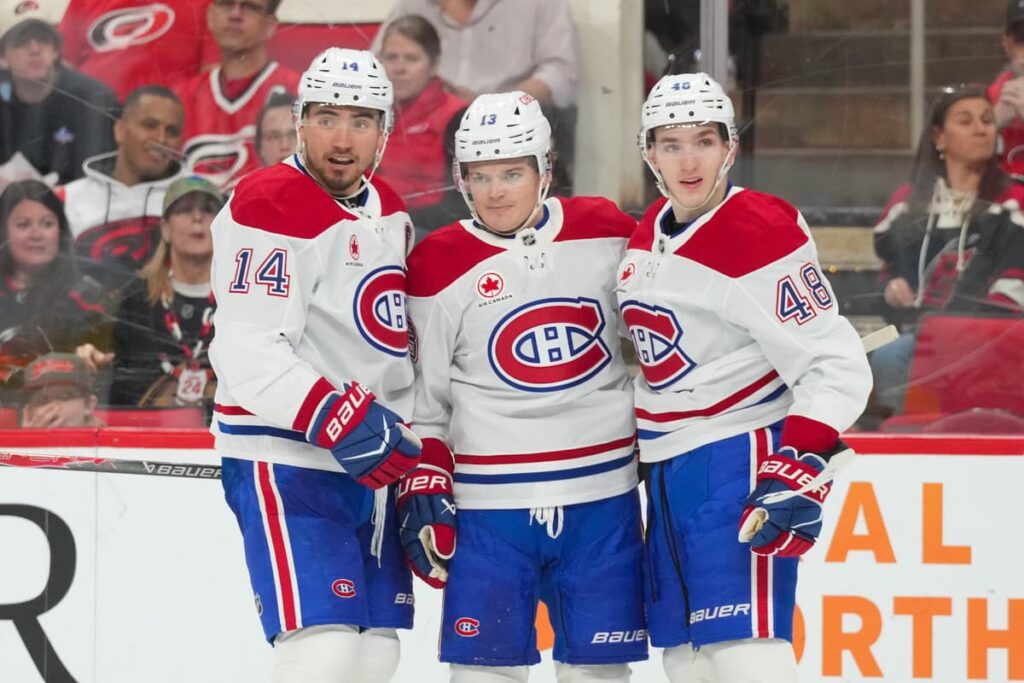
Before you sharpen your pitchforks, hear me out. The Canadiens are one of the most-punished teams by my model being descriptive instead of predictive. In a predictive model, all the great contracts signed to core players like Cole Caufield, Ivan Demidov, Noah Dobson, Lane Hutson, Juraj Slafkovsky and Nick Suzuki in a rising-cap world would catapult Montreal to the top quarter of the list based on the value they will save in the final years. But in a descriptive model, it only looks at the value those contracts bring right now. Since the market has just started to blow up, this means the Habs’ core is signed only to market-value deals going into this season. That will show in later installments of this series, as the market grows while this core stays at the same price.
It’s still a great situation for the Canadiens, but the problem is it doesn’t outweigh the rest of their roster, which features several bad contracts, some of which are locked in to term. The most notable of those is the mid-season extension given to Mike Matheson, which made zero sense for Montreal. He’s already 32 and has seen his play decline, yet he received a raise on his previous contract with a five-year term. Contracts like his hurt the Habs’ overall cap picture, as any money saved on the great deals for their core players is wasted on aging veterans. Other poorly rated contracts like Josh Anderson’s, Kirby Dach’s and Alex Texier’s at least had minimal term to them, but Matheson’s could inflict some long-term damage.
Overall, this paints a similar picture to the problem with the current Montreal roster: the core players are fantastic and dominate when they’re on the ice, but the rest of the roster doesn’t bring enough value, holding the core back. It’s why they were picked apart against the Carolina Hurricanes in the Eastern Conference Final, and it’s why they are hindered in the cap rankings.
Last Year: 18th
Contract Rating: 30th
Contracts with No-Trade/No-Move Clauses: t-3rd
Dead Cap Space: 19th
Quality of Contractual Core: 15th
Cap Space to Team Quality Differential: t-15th
Doug Armstrong ends his run as the longest-tenured general manager in the NHL, passing the torch to former Blues player Alex Steen. Steen’s reward? A salary-cap sheet littered with bad contracts. Some of these deals were for players Steen signed or acquired since taking over, like Brandon Carlo, Connor McMichael and Mason McTavish, but others have existed for a while. Whether it’s the smaller cap hits for replacement-level players like Ross Johnston or Alexei Toropchenko, or the bigger names who haven’t lived up to their value like Jordan Binnington, Pavel Buchnevich, Cam Fowler and Colton Parayko, St. Louis has plenty of players on bad contracts to worry about.
The Blues do have a few good-value deals to balance it out, including some on the more expensive side like Dylan Holloway’s (+42) and Robert Thomas’ (+32) contracts. It’s impressive because, with my contract rating, the more expensive the salary, the harder it is for a player to rank well above that salary on the market. But despite Holloway and Thomas having the respective 64th- and 48th-highest cap hits among forwards, they rank 22nd and 16th in my model.
It’s not all bad for St. Louis, as they rank in the top 20 in every other category. However, having too many bad contracts can be difficult to navigate. It will come down to what direction they plan to take. If it’s a rebuild, then they have time to let some of these bad contracts filter out. But if it’s a retool, Steen may be operating with a hand tied behind his back.
Last Year: 26th
Contract Rating: 12th
Contracts with No-Trade/No-Move Clauses: t-17th
Dead Cap Space: 20th
Quality of Contractual Core: 18th
Cap Space to Team Quality Differential: t-15th
The biggest story for the Wild this summer is whether Quinn Hughes will extend with the team. Aside from the potential term improving the quality of Minnesota’s core, Hughes’ extension won’t have a large impact on the team’s ranking this season. It will at least justify some of the other middling work Bill Guerin and Co. have done to surround their core, but that work also cost them value elsewhere in the lineup, which is why they lack the room to improve their shallow lineup.
The most notable of Guerin’s sloppy work around the edges was with Michael McCarron. The Wild paid a significant price to not only acquire the center (a second-round pick) but also to re-sign him in the summer, locking him up to a six-year deal with a $3,333,333 cap hit. That contract is too much for a player who is at-best a third-line calibre player in his own end and brings nothing else to the table.
It’s not all bad for Minnesota. They have their core (except Hughes) locked up long term to solid-value deals (even Kaprizov’s at his hefty price). The Wild have also found value elsewhere in the lineup, whether through the money they signed the Foligno brothers to, or by moving off Jacob Middleton’s contract and bringing in valuable contracts in Blake Coleman (at 50% retained) and Olli Maatta in the same trade with the Calgary Flames. But when the Wild still have a decent chunk of dead cap space on the books with Zach Parise and Ryan Suter’s buyouts (although not to the extent they used to), Guerin needs to smarten up with his depth signings, especially if it hurts them in retaining Hughes.
Last Year: 5th
Contract Rating: 10th
Contracts with No-Trade/No-Move Clauses: t-23rd
Dead Cap Space: t-1st
Quality of Contractual Core: 20th
Cap Space to Team Quality Differential: t-27th
The Golden Knights are one of a few teams coming up who fall under the same umbrella: teams who were elite at managing their salary cap, never falling out of the top 10, until this season. You’ll have to wait until next week for the other two, but the Golden Knights were one of the consistently stronger teams before this year. They never finished higher than fifth but also never lower than eighth, reflecting a team known for ruthlessly making the smart choice. But, all runs must come to an end, and with Vegas, it comes with lapses in judgement this summer, where they settled for sunk-cost fallacies instead of shipping those players out.
The most notable of Vegas’ mistakes was re-signing Rasmus Andersson to an $8.5 million AAV for seven years (a -91 contract rating). The Golden Knights also shipped out two players with better-value deals, Zach Whitecloud (-1) and Kaedan Korczak (62), to acquire and retain Andersson. Jeremy Lauzon, another player with a bad contract Vegas signed this summer, also could have been let go to retain Korczak. But now both Lauzon and Andersson negatively impact the team’s contract rating and the quality of their core. It also doesn’t help that Adin Hill and Carter Hart are two of the weaker regular goaltenders in the league and are signed for a combined $8.25 million, especially after they shipped out the Vezina-caliber Logan Thompson.
To be fair, those contracts make up most of Vegas’ blemishes. A poor regular season also impacted many of their players in my model despite this team otherwise being a Stanley Cup contender. That said, this is a sign of what’s on the horizon for Vegas. They’re a team who have chased contention for their entire existence, rarely seeing their prospects play for their own team at the expense of acquiring talent to win now. It worked, as it’s given them a Cup and two other Final appearances, but time has to run out eventually.
_____
PRESENTED BY THE DAILY FACEOFF NEWSLETTER