Kaiden Guhle and the High-Stakes Dilemma Facing Canadiens GM Kent Hughes – The Hockey Writers –
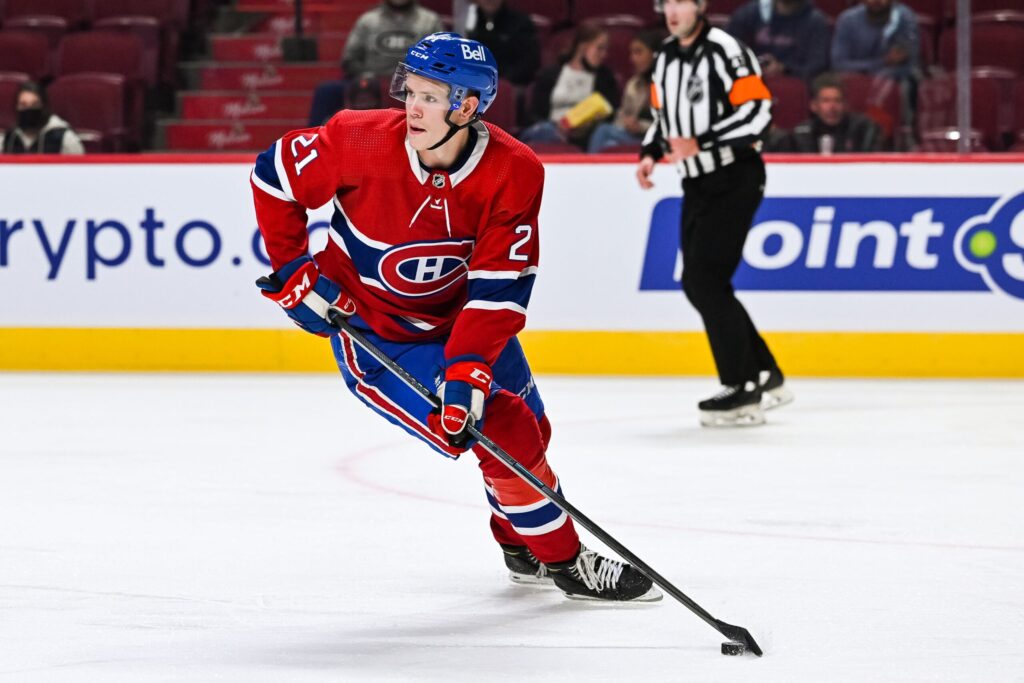
There comes a time in every meticulously planned rebuild when a general manager (GM) has to look at his board, swallow hard, and consider trading away something that genuinely hurts to lose. For Montreal Canadiens GM Kent Hughes, that moment is fast approaching.
Montreal has successfully navigated the teardown phase. They’ve accumulated the draft capital, reshaped the culture under head coach Martin St. Louis, and established a young core group of players considered to be one of the best in the NHL. But as the Canadiens prepare to pivot from an up-and-coming storyline into a legitimate, year-in, year-out Stanley Cup contender, their biggest remaining void is glaring: they need another dynamic, game-breaking top-six forward.

And to get a real one, the kind that doesn’t just fill a spot on a second line, but can actually make an impact in the playoffs, Hughes is going to have to part with a player he loves. Enter Kaiden Guhle.
Depth Is the Strength
Now, let’s be clear: suggesting the Canadiens should trade Guhle isn’t a critique of his game, far from it. Since his arrival in the league, the 24-year-old blueliner has been everything the franchise could have envisioned when they selected him 16th overall in 2020. He plays with an edge, blocks shots with reckless abandon, skates out of trouble effortlessly, and willingly takes on the opposition’s heaviest line night after night, often while playing on his off-side without a peep of complaint. He is, in every sense, a Swiss Army knife; some would describe him as a warrior.
So why would Hughes even entertain the thought of dangling a cornerstone piece like Guhle? Because roster construction in the NHL means that at times you have to give up quality to get quality. And right now, Montreal’s greatest position of surplus overlaps directly with the rest of the league’s greatest area of need: top-four, cost-controlled defencemen. Look at the depth Hughes has built on the back end, especially on the left-hand side.
Lane Hutson has already proven his transcendent offensive instincts belong at the top of an NHL power play, and as he enters his third season, he is already considered one of the NHL’s top defencemen. Mike Matheson was recently extended, and he brings veteran leadership and a steadying presence while providing an elite skating, two-way defender who can control the transition game and can do so on a top pair.
Then there are several depth defencemen who can fill a third pair reliably, such as Adam Engstrom, Jayden Struble and Arber Xhekaj. The Canadiens don’t just have a good young defence; they have a logjam. There are simply more top-four calibre defencemen in the system than there are available minutes on St. Louis’ bench.
Guhle isn’t the trade chip because he’s expendable; he’s the trade chip because he’s the only one on the blue line with the exact combination of proven NHL pedigree, elite ceiling, and contract certainty that makes rival GMs pick up the phone and stay on the line.
When Hughes traded for Kirby Dach and Alex Newhook in back-to-back summers, he used draft picks and secondary assets to take calculated swings on high-upside players looking for a fresh start. But those were depth moves, or just moves fishing for higher potential. For a team still finding its legs. The next swing Hughes takes will be different. It will be for an established, prime-aged star forward, a true difference-maker.
Gotta Give to Get
Rival GMs who find themselves forced to trade that tier of forward talent aren’t interested in a package of three late first-round picks and a secondary prospect. They want an immediate, plug-and-play anchor for their own blue line. They want a player who can play 22 minutes a night, kill penalties, shut down top lines, and do it on a contract that won’t break their salary cap.
Guhle ticks every single box on that whiteboard. He is in the second season of his six-year deal, which pays him a highly manageable $5.55 million average annual value (AAV), another example of proactive cap management by Hughes. In an environment where the salary cap is rapidly rising, and upper-tier defencemen routinely command well over $8 million on the open market, Guhle’s contract represents absolute gold to any NHL front office. It guarantees five more full years of elite, top-four shutdown defence at a fixed price point.
Xhekaj Conundrum
But why not trade Arber Xhekaj? He’s “out of favour” with the coaches because he’s used all season sparingly, gets little ice time when he is dressed, and there’s no hiding from the flaws in his game, right? All true. The discipline remains a work in progress, and his defensive positioning can be confusing. Also, when he’s left in the press box for long periods as a healthy scratch, the rust in his game, especially in high-pressure situations, is pronounced.
Context, however, is everything. When you consider that no blueliner on the Canadiens’ roster has been handed less consistency in terms of ice time and deployment, a case can be made that Xhekaj has actually held his own quite admirably at the NHL level. If left to play in a bottom-pair role, with the same partner, he can focus on his own game, and then his game simplifies and settles into more predictable outcomes.
For the exact same reasons rival NHL GMs keep calling Hughes to check on his availability, the Canadiens would be intent on keeping the physical fan-favourite in the fold. That’s especially true given his cap hit won’t require a massive leap from the modest $1.3-million AAV on his previous deal.
If the choice of who is better left in a bottom-pairing role behind Hutson and Matheson, Xhekaj or Guhle, it is clearly Xhekaj. While he isn’t as versatile or impactful as Guhle, he can provide good value for little cost in a limited role.
A Highly Valued Defenceman
Imagine a scenario where a franchise is forced to market a top-line forward who has demanded a trade or refuses to extend their contract entering their final year. What other team in the league can offer a 24-year-old, top-four proven, mobile, and physical left-shot defenceman on a long-term $5.55 million contract, while also dangling picks and prospects to sweeten the pot? Likely just Montreal. And that gives Hughes an immense leverage advantage if, and when, that tier of player becomes available.
None of this implies that a deal is imminent, or that Hughes is actively shopping a player who has quickly become part of the Canadiens’ leadership spine. The front office isn’t going to throw Guhle away in a panic move or use him to patch a short-term hole. Hughes has been remarkably disciplined throughout his tenure in Montreal, repeatedly preaching patience and refusing to skip steps in the organizational blueprint.
Hughes has noted on multiple occasions that he won’t make a trade just to appease the fanbase and then regret that move later on. The target, if Hughes pulls the trigger, will be someone who fits the exact timeline of the core group, headlined by Ivan Demidov, Cole Caufield, Nick Suzuki, and Juraj Slafkovsky.
Trading Guhle would hurt. It would leave a bruise on the roster and require the remaining defencemen to step into heavier defensive responsibilities immediately. Fans would lament losing a player who sacrificed his body on every shift for the Bleu-Blanc-Rouge. But the great GMs aren’t hired to make comfortable decisions; they are hired to build Stanley Cup champions.
Hughes has spent four years building a core and accumulating the assets required to buy Montreal a seat at the NHL’s high-stakes table. Now, with a blue line overflowing with young talent and an urgent need for an offensive catalyst up front, Guhle stands out as the obvious asset that rival GMs would desire in any deal that gives Montreal a key asset to finalize their reconstruction.
It’s a move born out of strength, not weakness, and it might just be the bold move that completes the puzzle in Montreal.
Free Newsletter
Get Montreal Canadiens coverage delivered to your inbox
In-depth analysis, breaking news, and insider takes – free.