Canadiens fill need in NHL Draft and still intend to fill a more pressing one via trade
BROSSARD, Que. — The Montreal Canadiens have created an expectation among their fans.
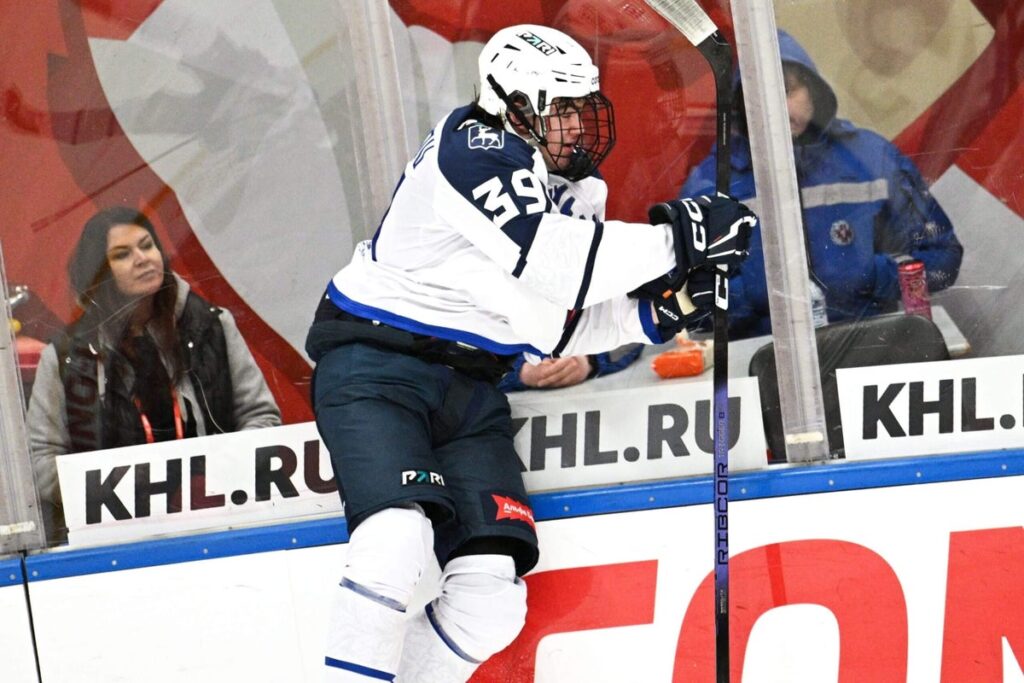
Yes, they will use the NHL Draft to add a young player to the organizational pipeline, and they did that Friday night by trading up two spots to select Russian winger Gleb Pugachyov with the No. 26 pick.
Pugachyov could very well have been the Canadiens’ best player available, as general manager Kent Hughes insisted after the completion of the first round. But the added reality is that Pugachyov fills a need, and while he will not be playing for the Canadiens anytime soon, the marriage of best-player-available and need was perfect for them.
Pugachyov is a battering ram of a player with enough offensive upside to think he might — might — one day be able to play higher up the lineup in the NHL. Hughes noted Pugachyov is eager to come over to North America as soon as possible, that he plays as if he is 250 pounds, and that the Canadiens tried trading up multiple times to get him before finally convincing the Vegas Golden Knights to accept an extra third-round pick in 2027 to move back two spots, allowing the Canadiens to get their guy.
The Habs take physical Russian winger Gleb Pugachyov
The Athletic Hockey Show
But in the grander scheme of things, the Canadiens did not get their guy. Or any guy.
Because the expectation they have created is that they will come out of the draft with not only a series of promising young prospects, but also more immediate help through a trade. And with the Canadiens coming off a trip to the Eastern Conference final, the appetite among their fans for a tangible, needle-moving trade was far more intense than for a somewhat abstract prospect, as promising as Pugachyov might be.
That expectation went unrealized on Friday, and the Canadiens remain status quo entering Day 2 of the draft. Last year, they acquired Noah Dobson ahead of the draft. Alex Newhook and Kirby Dach were also acquired at the draft. There was a pattern.
But the NHL reality has changed. There are very few rebuilding teams. The salary cap is rising at an unprecedented rate as opposed to remaining flat. The free-agent market is essentially a wasteland; every team sees the trade market as a way to improve.
But the most important change for the Canadiens is that they are no longer indiscriminately adding talent. They have talent. Their needs are more specific, and specificity makes trades more complicated to execute.
It is no longer enough for the Canadiens to look across the NHL landscape and tell themselves they need to find a talented forward. Instead, they need to look across that landscape and attempt to identify, for example, a player who would mesh well with budding star Ivan Demidov because there is a hole next to him on their depth chart.
And despite coming away from the first day of the draft unable to find that specific player, it was not for a lack of looking.
“We had conversations with several teams with respect to certain players,” Hughes said. “We don’t just look at what’s in theory available in the market as opposed to there’s a player on team X or team Y that we think would be a really good fit. I can pick up the phone and say, ‘Would you move him? Even if you’re not thinking of moving him, could we put an offer in front of you that would make you consider it?’ That’s kind of how we’ve always tried to do it, and that’s certainly been part of our M.O. this offseason, and probably more so because we’re looking for specific things.
“We’re not just looking to accumulate more talent, and then we’ll figure it out. I think we’re at a stage where we’re looking for — it’s great to continue to add talent, but we need it to help us in certain positions or in certain places.”
Trades like that are not as simple as flipping all the extra draft picks you’ve accumulated by liquidating veteran players that are not part of the long-term plan. But trades like that are also not limited by the parameters of the draft as a result, which means the end of the first round Friday night did not in any way represent the end of the Canadiens’ efforts to improve this summer, or perhaps even beyond that.
The Canadiens have always dealt from a position of surplus to address a need. That need used to be very general — more talent — and that position of surplus has largely been draft picks up until now. They no longer have a surplus of draft picks, but they do have a surplus of players they have selected with previous draft picks, players who are nearing NHL readiness but won’t necessarily have an available roster spot in Montreal to demonstrate that readiness.
But the problem is that the need is much more specific, which limits the number of teams they can deal with, and which also makes the desired return from those teams equally specific.
In other words, up until now, the Canadiens were playing a form of checkers. But they are now engaged in a game of chess where moves must be anticipated in advance.
Let’s take Hughes’ own hypothetical where the Canadiens identify a player on team X or team Y, but that team would rather have an established NHL roster player to convince them to trade that player who would fill the specific need the Canadiens are looking to fill. That would mean the Canadiens would need to engage another team that might be more interested in the prospects they are looking to trade to acquire that roster player that could complete the actual trade the Canadiens want to make.
That series of trades is not beholden to the draft, because there are no draft picks involved. But it is beholden to the Canadiens’ ability to gather the specific assets that specific team is looking for in order to acquire the player that would fill the specific need they are looking to fill.
“I think if you want a player you know is established and capable of helping in today’s market right now, you’re going to pay a pretty significant price,” Hughes said. “It doesn’t scare us. We just have to find the right player and have to be able to appeal to that team with what we have to offer.”
The Canadiens did not sit idle as trades were happening all around the league. They just decided to sit them out unless that specific need was filled, or value could be found. For instance, you could look at the New York Rangers trading a first-round pick and a third-round pick for restricted free agent Pavel Dorofeyev, and then signing him to a seven-year deal worth $11 million a year, as an opportunity lost. But Dorofeyev was not viewed by the Canadiens as a player who filled their specific need of a top-six wing to play with Demidov, at least not ideally.
You could also look at the relatively low cost of the St. Louis Blues’ acquisition of centre Mason McTavish from the Anaheim Ducks — the No. 15 and No. 29 picks in the first round Friday night — as a missed opportunity. But we’re told the Canadiens inquired there as well, and had that trade fallen through because the player the Ducks wanted at No. 15 — Nikita Klepov — was not there, the Canadiens had established a window to make an offer.
But ultimately, the Canadiens believe they remain in the game to make the trade they are really looking to make, because there are still unresolved situations around the league despite all the trade activity we have already seen. The mess the Columbus Blue Jackets are dealing with right now would be only one example of that.
And Hughes made it clear that this trade of precision will take the time it needs to take.
“I’m confident we’re going to be able to do something,” Hughes said. “I can’t tell you when, but I feel we’re in a position to do it. We’ll just do it when it makes sense.”
That could be this week. It could be next month. It could be at Christmas.
Whenever it happens, it is clear the Canadiens feel they have accumulated the assets necessary to make a trade to improve their team; it is clear they have a desire to make that trade; and it is equally clear they will not feel forced into making a trade that is less than ideal just to satisfy external expectations or to match what other teams are doing.
But they will continue pursuing that trade.
“It’s up to each general manager to find a way to get it done. To me, there’s no excuse,” Hughes said. “We need to find a way to improve the team, and it’s on my shoulders to do it.”