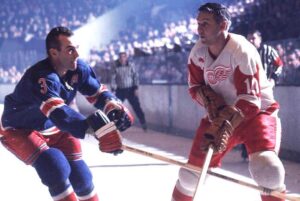
Todd: Claude Lemieux knew what it took to win
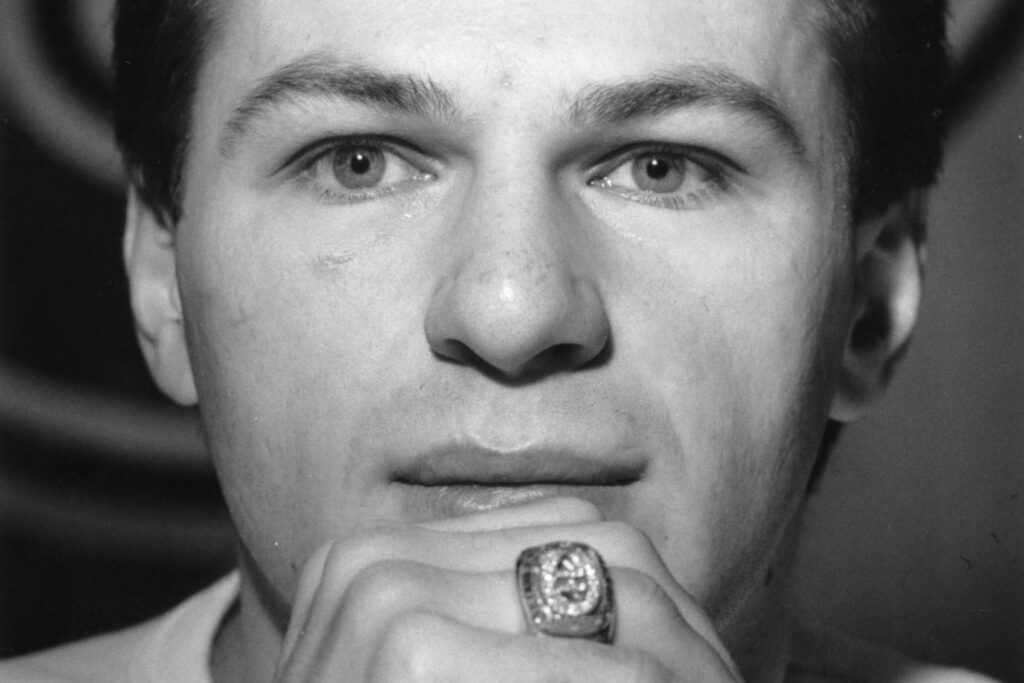
The grey-haired gentleman standing outside the Bell Centre looked as powerful as ever. The big shoulders, thick wrists, paws like catcher’s mitts. Strong enough to hold up the torch he was carrying.
That was Monday evening and Claude Lemieux appeared capable of taking a shift or two against the Carolina Hurricanes if the Canadiens needed him for Game 3 of a series that has gone badly off the rails for a team that looks drained, enervated, spent.
Thursday, the shattering news broke that Claude Lemieux had died at the warehouse of his family business in Florida early Thursday morning at age 60. By Thursday afternoon, his death was reported as a suicide and a difficult week for the Canadiens had turned tragic.
Shockwaves radiate in all directions when a man who seemed so vital dies so soon after his last public appearance, especially when a city is caught up in one of those Canadiens springs when the universe seems to revolve around the CH.
There will be questions. Anyone who follows the game knows the line they will take, from hockey injuries to CTE, chronic traumatic encephalopathy, and the depression that accompanies it — but this is not the time to speculate.
For a player who was not here that long and was never a superstar, Lemieux cut a wide swath. In the Stanley Cup spring of 1986, the rookie Lemieux played 10 games during the regular season and produced a single goal and two assists. In the playoffs, he played 20 games, scored 10 goals and six assists — a pattern that would hold through most of his career and result in a ring or every finger on one hand.

Some of the most revealing comments I have ever seen from Lemieux came in an interview he did several years ago with Newfoundland hockey blogger J.T.:
“I always say the biggest goal I ever scored was against Hartford in, I think it was double overtime (it was actually the first overtime period), Game 7. I’m always going to remember that goal as my most exciting, memorable goal. I still remember scoring it and skating toward the bench and diving on the ice with all my teammates on top of me.”
“It really struck me what it meant to win in Montreal when Larry Robinson was the last guy to congratulate me and he was hugging me and he wouldn’t let go. It was just he and I pretty much left on the ice and he just kept hugging me, then he let go and I saw he had tears in his eyes. He was crying.
“I thought, this is crazy. This man has won so many Stanley Cups already and he’s been around forever. But that is what winning does for you and that’s what it means to be a Montreal Canadien. It’s quite special.”
Lemieux was that rarity, a serial pest who was actually tough.
Lemieux was that rarity, a serial pest who was actually tough. He was a 6-foot-1, 225-pound load and he feared no one. To use a word I despise, he gave the hockey world an iconic moment while playing for the New Jersey Devils. Lemieux was on the bench and one of his teammates was tangled up with Eric Lindros right in front of him when Lemieux took a sly look around to see where the officials were — and sucker-punched the fearsome Lindros right on the jaw.
Lemieux, however, had another side. As Michael Farber once wrote, he had two positions — right wing and prone. He was often suspected of feigning injury, to the point where crusty coach Pat Burns had seen enough. During the Stanley Cup final against the Flames in 1989, trainer Gaétan Lefebvre was about to hop over the boards at the Saddledome to come to Lemieux’s aid when Burns stopped him.
“Let the SOB lie there,” Burns shouted, and Lefebvre did as he was told.
Lemieux would play one more season with the Canadiens, though an abdominal injury confined him to 39 games in 1989-90. During the off-season, his periodic feuds with Burns had finally reached the breaking point. Lemieux refused to report to training camp with his teammates in Moscow and after he went to general manager Serge Savard and asked for a trade, he was dealt to the Devils on Sept. 4, 1990.
It was a deal New Jersey GM Lou Lamoriello clearly won: Sylvain Turgeon to Montreal for Lemieux. Turgeon had skills, Lemieux had all those intangibles that lead to Stanley Cups, as they did for New Jersey in 1995 when he won the Conn Smythe Trophy while scoring 13 goals and leading the Devils under former Hab Jacques Lemaire to their first Stanley Cup.

For reasons no one can explain, the Stanley Cup seems to follow players like Lemieux around. He was in Colorado in the fall of 1995 when Patrick Roy was traded to the Avalanche and Lemieux and I had our only close encounter then.
Farber and I were invited to take the team charter from Denver to Ottawa after Roy played his first game for the Avalanche. On the team bus from the airport to the hotel in Ottawa, I grabbed the seat next to Lemieux. As we chatted about nothing much, I noted something I would never have seen otherwise: those massive, powerful hands. Hands I’ve seen on only two other players, John Ferguson and Vladislav Tretiak.
Hands that were meant to lift the Stanley Cup, which Lemieux would do again the following spring with Roy in Colorado and one last time in 2000 when he was back with New Jersey.

Lemieux knew better than most what it took to win: belief. “I don’t think it’s magic,” he once said. “I think everything runs downhill. From the top down if you have winners at the top, it starts to spread. Losing spreads through your locker room quickly, but so does winning.”
In a sometimes brutal sport, Claude Lemieux was a winner.

Help is available if you or someone you know is struggling. Call Info-Social at 811, Option 2. If you are having thoughts of suicide, call 911 or Suicide Action Montreal at 1-866-277-3553.