Mayhem and the Maple Leafs — The Fourth Period
I always wondered if he would be back.
I always wondered when he would be back.
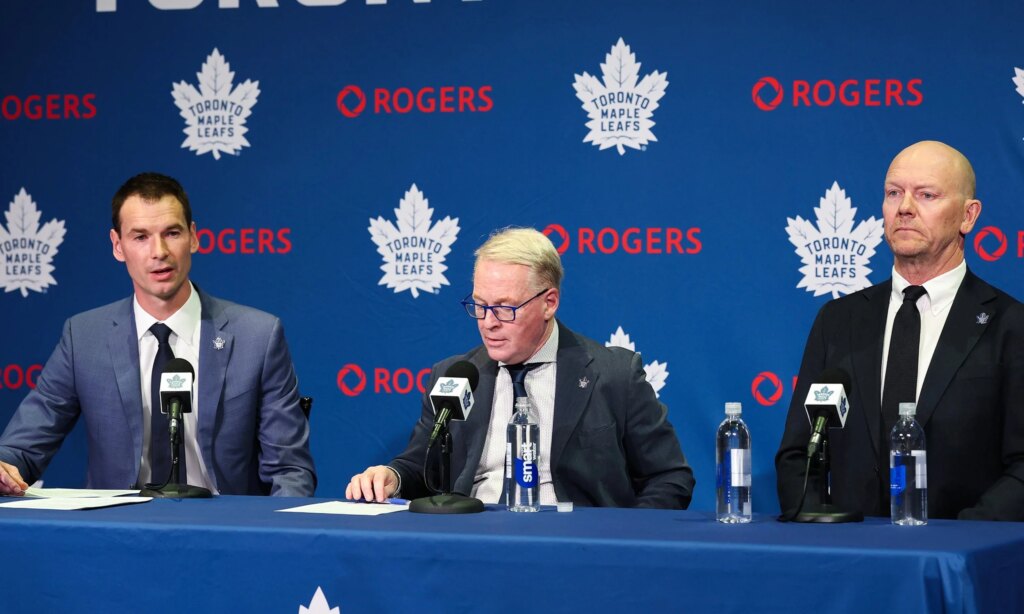
So, it’s not a surprise to see John Chayka back in the NHL. To get the seat of the most famous and valuable franchise in the hockey world? That’s another story.
We’ve all been inundated since the instantly infamous press conference this past Monday with Leafs’ talk. Conversation that is overwhelming the excellent playoff hockey we have and are continuing to see. Colorado-Minnesota has been an 80s-style track meet. Montreal-Buffalo has a 100% chance to be fantastic (Adams Division represent!). Then out west, we’ll see if Anaheim’s youth and speed has the answer for a veteran Stanley Cup-winning Vegas squad that Utah did not. (The Carolina-Phili series is, inevitably, already almost over.)
But alas, as it is the epicenter of the hockey world, we talk Toronto. And as always, here’s a take that I guarantee you have not yet heard.
There is an overly simplistic axiom that states, “Everyone deserves a second chance.” That’s not always true, but for the sake of argument, go with it.
Look at the NHL this year.
Joel Quenneville, who was the head coach of the Chicago Blackhawks at a time when two of their players were sexually assaulted by one of Quenneville’s staff, was allowed back in the NHL. Look at two years ago when Stan Bowman, the General Manager of that same Blackhawks team, was allowed to once again work in the NHL.
So, let’s get this out of the way really quickly. Did John Chayka make mistakes? Abso-freaking-lutely. If the NHL has a culture that allows people such as Quenneville, Bowman, Kevin Cheveldayoff in Winnipeg (part of that Blackhawks’ management group), etc. to have gainful employment within the league, then I see no issue why Chayka should not.
While I’m on the soapbox, let’s take it one step further. We are hearing from every connected source – from newspapers to insiders to paid subscription models – that the vast majority of general managers will not want to deal with Chayka. If they are willing to deal with the leaders that failed the young men who needed to be protected in Chicago, then I really have a hard time seeing why they cannot extend the same courtesy to Chayka.
(Aside: Regarding the press conference on Monday, whether you are a young person either close to or who has recently embarked on the start of your career, or you have been in the game a long time and are starting to let your guard down, take it from someone who has hired people for a living for the past nearly five years and now leads the teams who do: Tone matters. Professionalism is always in style.)
If you are someone with any power within an NHL team (and I know that some of you are here because you look at my LinkedIn profile, say Hi next time, I don’t usually bite), I strongly recommend figuring out a way to give this message to your leadership. The idea that you would cut off a pipeline of talent and resources because you are upset about something that, in the grand scheme of things, is both not a big deal and can be logically explained, is incredibly narrow-minded, short-sighted, and frankly, poor leadership.
While this has been covered somewhat, let’s dig deeper. At age 25. Chayka was the Wunderkind, an assistant GM with an NHL club at an age where most men can’t figure out 3/4 of what life is throwing at them. One year later, Chayka was the youngest general manager in NHL history. Now granted, it was for Arizona, still though. The next Sam Pollock had arrived.
For those of you that are reading this and are in your mid-30s, your 40s, or older: do you remember what you were like when you were 26? When your pre-frontal cortex had only just finished forming, how many good decisions you made versus how many mistakes? How much learning you did? Now, take what you know about billionaires. Are they always on the up and up, or are they sometimes capable of manipulating people in situations to fit their agenda? It is not at all difficult to see a world where Chayka – young, a legitimate genius and prodigy, was amped up to make the best impression possible, and Alex Meruelo and the Meruelo family saw Chayka as someone that they could take advantage of. Pinocchio, meet Geppetto.
The Meruelo Family/ownership group was not exactly known for its desire to spend large sums of money and build a winning team, nor were they known for having any sort of workplace decorum, or, you know, paying people. They had Chayka make trades to acquire contracts like that of Pavel Datsyuk’s, who while still on the books, was no longer an NHL player, so that they could simply hit the salary floor. The floor. They say that Toronto is not a serious team, well the Arizona Coyotes were not a serious team.
Knowing how they operated, it is very easy to envision a conversation between one of the Meruelos and Chayka where it was expressed to Chayka that it would be good to save money on physical testing on players if you go and meet them yourself. Being young, smart, and overconfident in his level of intelligence, it again is not difficult to see a world where Chayka thought he could get away with what he was being asked to do. To be clear, I am not saying that this is what happened. It is simply a logical conclusion that can easily be drawn when looking at the situation.
What makes it even easier to be drawn is how, both in Monday’s press conference and subsequent interviews, Chayka was exceptionally cautious in the words he chose when speaking about the leadership in Arizona. At no point did he say the Meruelo name or reference ownership. And he only vaguely referenced the general issues that the public was aware of, such as needing to build a new arena, which felt like a misdirect of the highest order. Of course, the arena issue was a challenge. But that was not a challenge under his portfolio. While it would have affected him to some extent, if he had been given the budget and the resources that a team like Toronto can offer, he would have been better set up for success.
Chayka’s biggest anchor in Arizona was ownership. Yet the silence around the Meruelo name was deafening.
Which brings us to the Why.
Twenty-seven people. That is how many people apparently interviewed in some form or fashion for the GM position of the Maple Leafs. Several up-and-coming AGMs. Known entities like Mike Gillis (who do not need the Keith Pelleys of the world micromanaging them). People that had played key roles in the management groups of recent Stanley Cup-winning teams.
How exactly did we land on someone who had been shunned from the league?
Oh yes, second chances.
The Wunderkind. The Genius. The man ahead of his time, co-founder of Stathletes, and a successful businessman to boot. This is Toronto, where they have decided they need to (once again) heavily leverage analytics. And they’ve made no bones about the fact that they are here to make money. Looking at all of this and taking his reputation out of the conversation, is it really that much of a surprise to see that an analytics guru with a successful background in making money who has been in the General Manager’s seat before was hired?
It’s easy to give second chances to elite talent. And in this case, under an MLSE umbrella that now charges children exorbitant prices to waive a flag at center ice and takes away perks from its staff (culture alert), it’s easy to give second chances to elite talent that is coming in cheaply.
Back when Chayka was with Arizona, then-President Brendan Shanahan was making $2.5 million per year overseeing hockey ops in Toronto. As per HockeyZonePlus, according to the book Hockey Hot Stove by the great Al Strachan, when Shanahan re-signed in 2019, he doubled his pay to $5 million per year.
While Shanahan was earning his $5M per, ex-GM Kyle Dubas was apparently making $4 million per year (scroll down). This means that for the 2023-2024 NHL season, the Toronto Maple Leafs were paying two executives a combined $9 million per year. In spite of the good overall work that Shanahan did in rebuilding the Leafs’ team and culture, his services were deemed to no longer be needed by MLSE President and CEO Keith Pelley, and perhaps the board, who knows. A month and a half later, Masai Uriji, who held the same title for MLSE’s Toronto Raptors as Shanahan did for the Leafs, was also let go. Now we’re saving money winning championships.
For the second chance that he is being given, and the simple fact that he is being given it, I do not think for a second that Chayka is making the $4 million that Dubas made, or anything close to it. If he is even at $2,000,000, I would be shocked. With incoming really-weird-title-that-doesn’t-properly-encapsulate-what-he’s-going-to-be-doing Mats Sundin, I would be shocked if he’s not making potentially twice as much as Chayka is. Combined though, maybe that hits the $4 million that Dubas himself was making. I definitely can’t see it being more than 50% of the combined $9 million that Dubas and Shanahan were making each year. This allows Pelley to try and make it look like he isn’t cheap, that the Leafs aren’t cheap, and that they’re willing to put in a new Shanahan after being called out for being cheap for letting go of Shanahan and Uriji. But let’s call a spade a spade. While he says he has done some work with the “Swedish National League” – which I can only assume to be the Swedish Elite League – and he has been watching the NHL on TV the past few seasons, Sundin does not bring the breadth of experience that Shanahan brought even as a new President. To be frank, Sundin is a poor man’s Shanahan, someone who has a much steeper uphill learning curve if he wants to be the President of hockey ops.
Except the thing is, if we’re expecting Sundin to play the Shanahan role, I think we’re all looking in the wrong direction.
Chayka has publicly stated that if Sundin does not like one of his ideas, he will not do it. Call that a President, call that an advisor. Bottom line is it’s power.
Sundin knows the game, he is a Hall of Famer who understands hockey and hockey players better than just about everyone who is reading this article and definitely the person typing it. Accentuate your strengths, hide your weaknesses. It’s one of the keys to a successful professional life. Sundin knows the game. He also knows how to lead. From the comfort of a $2,000 office chair, Sundin can open doors for Chayka with teams whose management didn’t read the top of the article and are too stubborn to want to deal with him. That’s only part of the deal, though.
Imagine, if you will: You run an elite franchise, and you have an absolute world-class talent leading your team. You have a vision for who you want them to be, and you present them to the world as though they are that person. However, those of us who have eyes and who can read body language do not trust what we see. What do you do to get the most out of that person, and have them become the person that you see them being?
I’ve said in the very recent past that he is not my captain. Of all people, Hollywood star and diehard Toronto sports fan Lauren Holly said yesterday that she does not care if Auston Matthews comes back.
First-overall draft pick. The best goal scorer of his generation. Our captain. And then, two completely different people, two completely different worlds and walks of life. The exact same sentiment. Because that is the energy, or lack thereof, that Matthews gives off. We get more information about what he’s thinking from insiders in the offseason than we do from him at any point during the year. And when he does talk? He looks unconscious, like he would rather be free-falling out of a plane at 20,000 feet sans parachute then telling the Toronto media – who are relaying it to the Toronto fans – how much he loves being here and wants to lead this team to a Stanley Cup or five.
Especially now that Toronto lucked into the 1st overall pick in this year’s entry draft, Matthews is not going anywhere, at least not this season. This is why they are paying Sundin however many millions of dollars(/less than what Dubas and Shanahan made) to move his family here from Sweden – to Lead. To wear the C on his suit. Sundin is here to show Chayka the way, and Sundin is here to show Matthews the way.
Look in Sundin’s eyes. You don’t have to look too carefully, because it’s obvious. Killer instinct. The eye of the tiger. The desire to succeed resonates from our longtime Captain. That is why he is here.
Pelley is Sundin’s Geppetto.
Sundin is Chayka’s Geppetto. And Matthews’. And anyone else smart enough to sit under his learning tree.
Will it work? Only time will tell. And it’ll start telling soon, as we’ll see if Toronto has the guts to draft Ivan Stenberg over Marner 2.0 Gavin McKenna in late-June. Then a few days later, the very limited free agent trickle gates open, where we’ll find out if anyone wants to fight the CRA for their tax-lowering signing bonuses and play for a team deep with offensive talent, but one for whom the GM has not earned anyone’s trust. Yet.